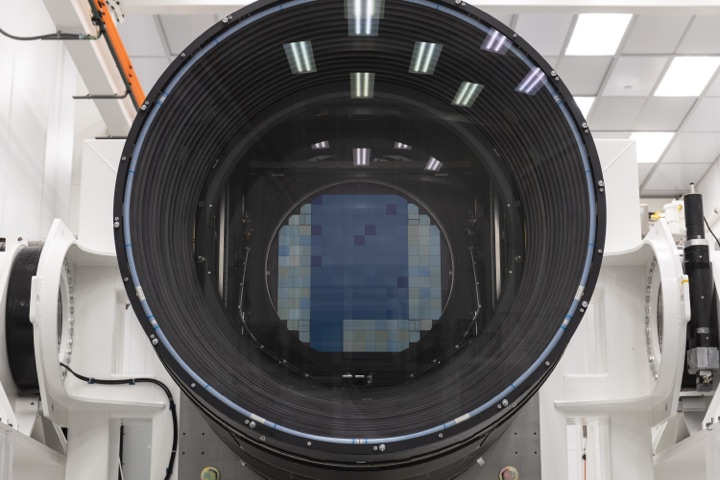
 As an observational cosmologist, my main research interest is the nature of Dark Energy, which I study through gravitational lensing. I am the Deputy Head of the Legacy Survey of Space and Time (LSST), the ten-year survey now underway as part of Vera C. Rubin Observatory operations. I played a major role in building the LSST Camera, the world's largest digital camera, and led the LSST Camera program through its construction at SLAC. I then served as Deputy Director of Rubin Observatory during its commissioning phase. Previously I was the Technical Coordinator for the LSST Dark Energy Science Collaboration.
My move into cosmology began with the Dark Energy Survey, where my research topics included weak gravitational lensing, three-point statistics, photometric redshifts, and an optics-based model for point-spread-function estimation. On the instrument side, I designed and implemented the Dark Energy Camera active optics system, which keeps the camera focused and aligned in real time, and was responsible for the active optics for the Dark Energy Spectroscopic Instrument.
I spent the first two decades of my career in experimental particle physics, mostly studying the difference between matter and anti-matter. With the BABAR collaboration, my group made the first measurement of the rare decay of the neutral B meson to two neutral Pions, and made a series of comprehensive measurements of B mesons into three Kaons, uncovering a number of matter-antimatter asymmetries. As a postdoc on the KTeV experiment, I led the construction and calibration of the CsI crystals for the KTeV calorimeter; KTeV made a definitive measurement of direct CP violation in the decay of the neutral Kaon.