Links on this page are categorized as follows:
Links to sub-pages of this paper are in
blue.
Links to media from the production are in
green.
Links to external references are in
red.
Reading Death in and out of Dumb Type's OR
In which Eli naively asks "what in the heck does this have to say about death?"
Dumb Type's website describes their production, OR, as a "'gray humor' reflection on the zone(s) that between life and death." [sic] On their site, they stress the ways in which the piece does this for the audience ontologically. That is to say, they talk about bringing the audience to a place of "white out" in which they turn off "intentions of grasping this mortal phenomenon." Using bright strobes, loud noises, frequent black outs, and confusing repetitive dances, they are trying to bring the audience to a "between" state (or to between them?) such that they reach some sort of understanding of the impossibility of grasping death.
To me, Dumb Type's performances beg to be opened up, to be read. Perhaps they are more coy than dumb? Watching OR, I could not help but try to make 'sense' of each episode in relation to the explicit and implicit themes of the performance. Perhaps this is a consequence of the critical distance achieved by watching it on video instead of in person. In any case, while OR highlights the impossibility of comprehending death, it does so not by refusing to grasp the phenomenon of death, but by visibly trying very hard to and failing. Many elements of the piece are very easy to "read" as traditional or novel metaphors or metonyms for a (post-)modern experience of death and dying, for example, the repeated use of long black-outs or the light-bar that runs across the screens.
It often seems, however, that although many of the images in OR are coherent reflections on death and dying, the piece as a whole often feels random, incoherent, or not well integrated. Various moments are strung together like a cabaret, and each beat and juxtaposition between beats make different amounts of sense. This moment, for instance, works of various levels more or less coherently. Dropping can be read a pretty clear metaphor for death. The fetish costume (corset, boots, and gas mask) and the trays are less legible. The S&M getup might pose a relationship to death and dying or medical procedure; a certain Eroticization of the body in relationship to technology, danger, and pain. The trays are probably there because they look pretty and make a great sound when dropped, but who can say? Each moment of the piece proposes a different relationship to the subject matter, sometimes very directly, sometimes less so.
OR, as the piece makes explicit, can be read as "ORientation." The audience is given two orientations in the form of text projecting across the wall. The first asks them to imagine themselves in a car driving south over the Alps, in a hurry to get to their destination, but able to relax once they arrive. Is this an orientation towards death? Certainly one might read this in relation the briefness of life in relation to the infinity of unlife. The moment towards the end of the piece when the actor/dancers lounge in lawn chairs for a time explores, perhaps, this possibility of death as peace, relaxation. The other "ORientation" that we get also involves driving through the Alps, but this time we have left something behind, which is a cause for anxiousness. For better or worse, however, a dance (see below) is taking place in front of the projection screens, and the camera seems to like it a whole lot more than text running across a wall. The mediatized viewer of the piece never gets to read more than a third of the second ORientation. (dumb type's website lists 6 ORientations, but I only remember [almost] seeing the two in the video... )
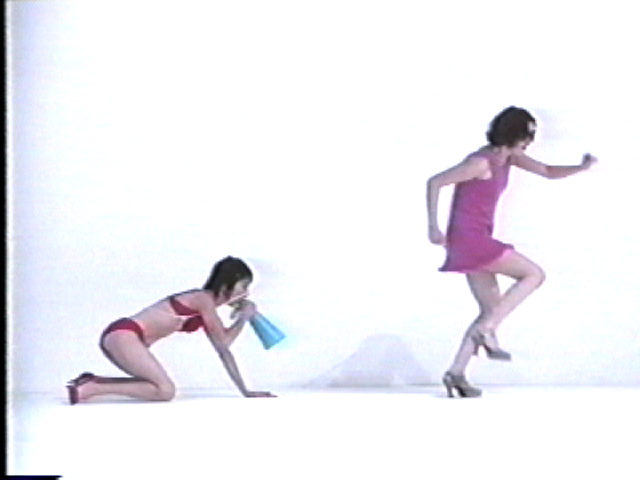
So what do these folks have to tell us about death? Maybe nothing. Maybe this dance has been placed in this piece completely arbitrarily so that we will try to read death in it and fail. Perhaps here Dumb Type is truly refusing to be anything but dumb, to simply stupify us. OR certainly resists any attempt to find a coherent subject position within it, except perhaps that of a kind of spectatorial screen forever fading out of existence as the performance projects onto us, sitting in the dark being assaulted by a strobe light. Is this like death?