Design Goals
- Suitable for flywheel energy storage
- High-speed operation
- High Efficiency
- Robust, low cost rotor
- Desired Specifications
- Rotational Speeds Up to 60,000 RPM
- Capable of at least 15 kW at 18,000 RPM (~8 Nm Torque)
- ~90% of energy stored in flywheel would fall between 18,000 and 60,000 RPM.
Stator Design
- Dimensions: 100 mm OD, 200 mm length
- Material: M-19 Silicon steel, 29 gauge (0.356 mm)
- Windings are 15 phase, concentrated-wound design. The stator has 30 slots, so each coil has a 180 degree pitch. Rather than using a traditional 3-phase configuration, I was interested in investigating a high-phase order machine with each stator slot corresponding to an individually controlled phase. One reason is that I wanted to confirm my suspicion that with a sufficiently high number of phases, the flux in the rotor would remain essentially constant, dramatically reducing eddy current losses in the rotor. I also wanted to be able to investigate the voltage waveforms for each stator channel individually.
- For each coil I assumed a 60% fill factor. The end winding length allows the winding to travel half the average circumference of the back-iron (150 mm), plus an addition 5cm to avoid the other windings. Thus, the total winding length is 2*(200+150+50) = 800 mm.
- Simulation was conducted assuming the current waveform in each channel was a sinusoid. This is merely a simplification of the problem as there is no reason to believe this is optimal. I believe that varying the current waveform as a degree of freedom in the optimization would be incredibly valuable in the future.
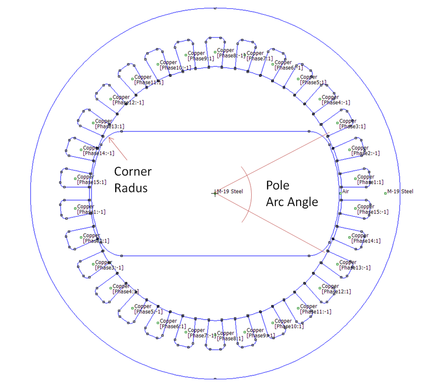
Rotor Diagram
Rotor Design
- Dimensions: 67mm OD. Airgap of 0.5mm (Apparently fairly standard in the industry, and rotor/stator can be stamped from same piece if the airgap is 0.5mm or above).
- I tested corner radii of 0, 6, 12, 18 mm, and for each optimized of the pole arc angle (see diagram above). I had hoped that radiating the corner would improve the power-factor, but that was shown not to be true.
- Single pole pair rotor. This means that the electrical frequency will be equal to the rotor frequency. This keeps the eddy current and hysteresis losses in the stator low even at high speeds (particularly because eddy current losses increase roughly with the square of frequency).