Simplified Parameter Space
For this project, the only parameter being optimized was the rotor pole arc for four discreet corner radii (0mm, 6mm, 12mm, and 18mm). This was simply to reduce the time required to complete the optimization on my single machine. However, there are many additional parameters of interest. First, there are a large number of potential rotor shapes not just those parameterized by pole arc and corner radius. Second, the stator parameters are of great interest in optimization as well. Slot depth, slot corner radius, inner radius (and equivalently rotor radius), and tooth arc angle are all dimensions that are of great interest. Of course, increasing the OD (and thus overall size of the machine) should also be optimized for a given application.
Phase-Angle Optimization
One non-design parameter that need to be optimized for each individual design was the electrical phase angle offset. Roughly speaking the electrical phase angle should be 45 deg apart from the rotor. At low current/B-fields, this is correct, but the stator back iron passes the linear part of the B-H curve, the optimal phase-angle offset changes. Thus, for each phase current amplitude for each motor design, the optimal phase angle must be found. This was computed roughly to within 2 degrees. (I actually used an algorithm very similar to the hill climbing algorithm we used for the MPPT in class).
Objective Function
Because I fixed the stator design, and only changed the rotor geometry, the cost of the any of the tested motors would essentially be identical, so motor efficiency was used to create the objective function. For simplicity, I used the mean efficiency in the proposed operating range of the motor, which was 1-15 kW, 18-60 kRPM, shown in the diagram below.
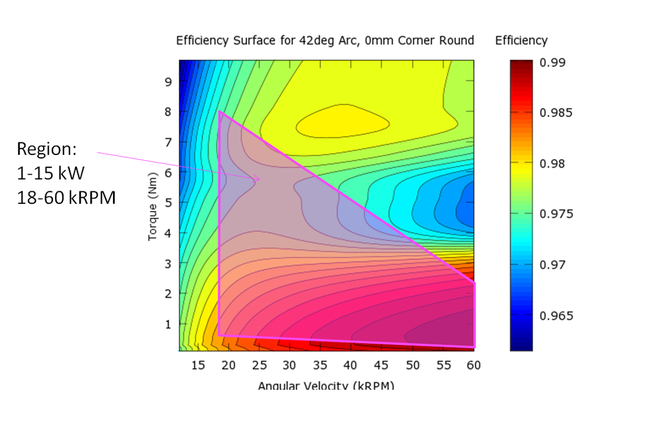
If a more complete flywheel energy storage system were part of the model, weighted mean based on the use-statistics would be a more effective objective.
Optimization Results
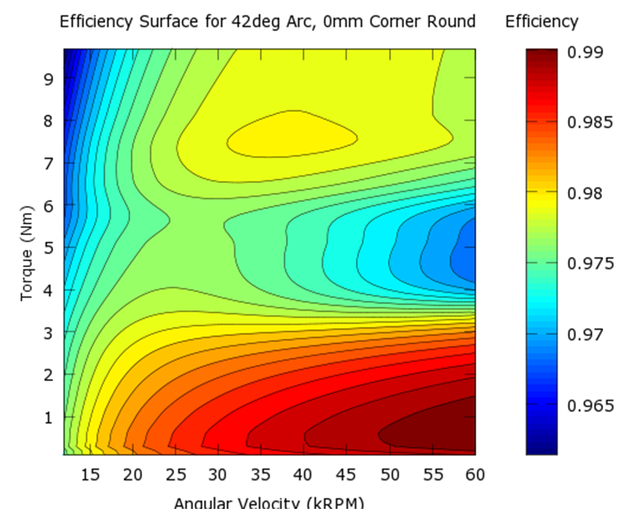
|
Optimal design for 0mm Radius @ 42deg Pole Arc
|
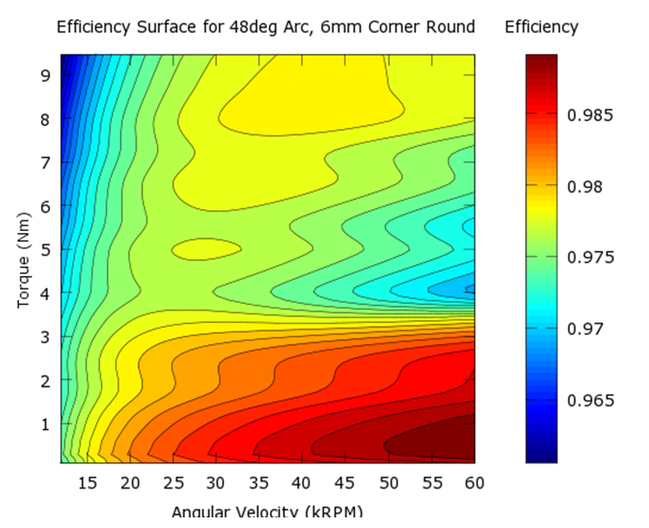
|
Optimal design for 6mm Radius @ 48deg Pole Arc
|

|
Optimal design for 12mm Radius @ 48deg Pole Arc
|
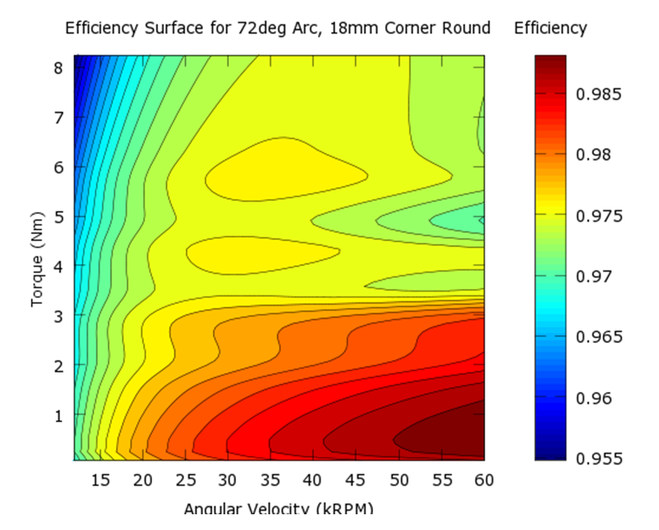
|
Optimal design for 18mm Radius @ 72deg Pole Arc
|
Below are finite element snapshots of the optimal designs for each corner radius.


