Time Series Simulation
Using the designs found from the optimization, I ran the following grid of simulations to generate the phase voltage wave-forms:
In the following plots, phase voltage is actually in units of V/kRPM/Turn. It is computed by measuring the flux-linkage in each coil, and taking the gradient with respect to rotor position. By symmetry we can reconstruct the full 360 degrees of each coil from the 12 degree sector simulated.
- Rotor angle in 0.5 deg increments from 0 to 12 degrees (all that is needed due to stator symmetry)
- For each rotor angle I tested an array of electrical phase angles in 2 deg increments from ±18 degrees around the optimal phase angle
In the following plots, phase voltage is actually in units of V/kRPM/Turn. It is computed by measuring the flux-linkage in each coil, and taking the gradient with respect to rotor position. By symmetry we can reconstruct the full 360 degrees of each coil from the 12 degree sector simulated.

In this plot the effect of rotor skew is demonstrated. I tested a number of different skew options, but ±6 degrees around the optimal phase-angle offset was the best in every situation. We see that the skew essentially eliminates the high-frequency voltage ripple, even for the 0mm corner case, for which the ripple is the worst. It also nullifies the torque ripple.
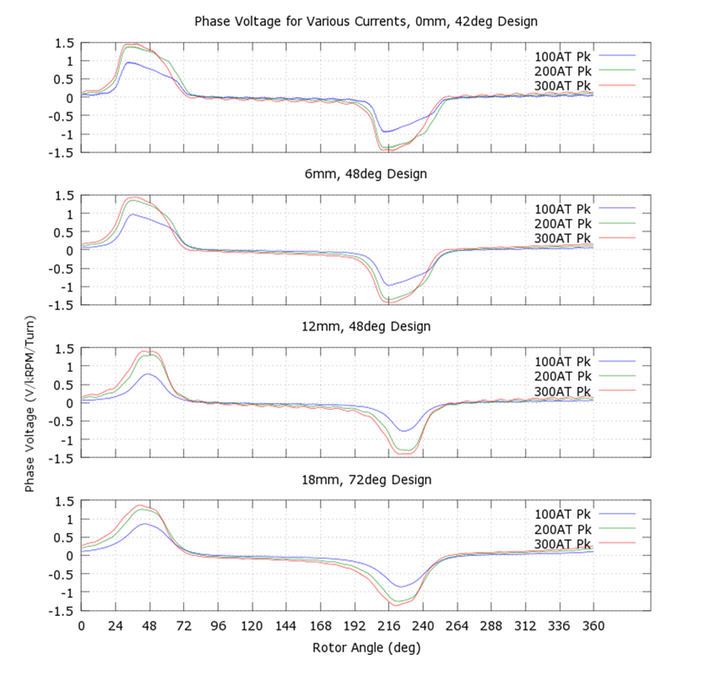
This plot shows the phase-voltage waveforms for each of the designs at 100, 200, and 300AT peak-peak. First, we note than in every case, the voltage levels off as the phase current increases as the flux approaches its maximum B-field. Second, it is clear that increasing the corner radius does not improve the power-factor, as I had hoped. Below I show a plot of the normalized voltages against the normalized phase current:
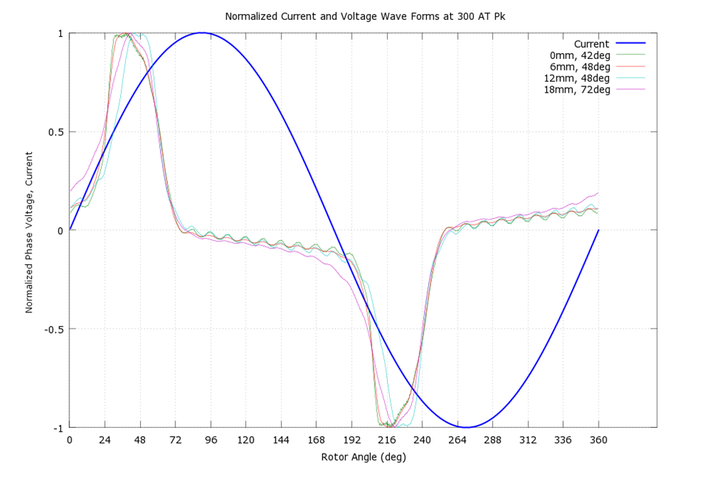
Here we note that the power factor here is quite poor, and as we will see in the study of possible inverter transistors, is problematic from an efficiency standpoint.