Install Qt Creator on Linux
Below are basic instructions for installing on Linux that may work for your system, however, we are unable to provide further Linux support. If you are unable to get Qt Creator working on your Linux system, please consider using another computer or working on a campus cluster computer.
1) Install prerequisites
If you're running Ubuntu, Debian, Mint, or any other Debian derivative, issue the following command in your shell:
sudo apt-get -y install build-essential openssl libssl-dev libssl1.0 libgl1-mesa-dev
If you're running some other variant of Linux, figure out a way to install the tools make, g++, and gdb.
(For example, on Fedora / Red Hat systems, you may be able to use the yum package manager.)
2) Download installer
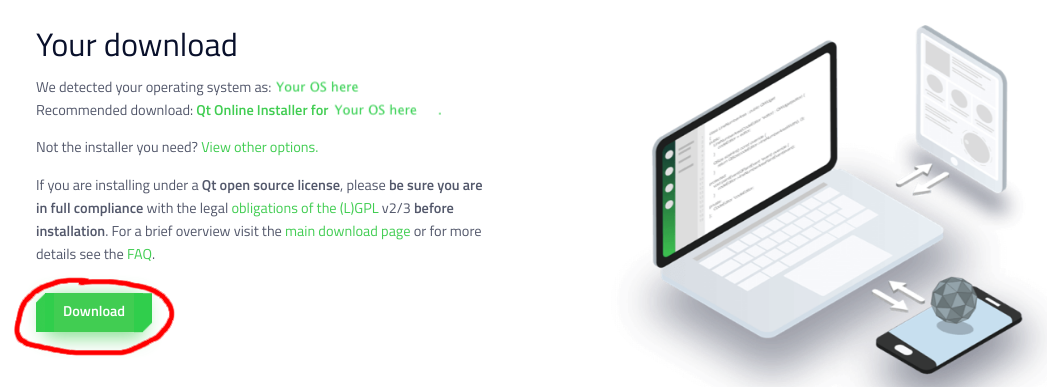
The Qt Creator official download site is https://www.qt.io/download-qt-installer. When you go to this site, it should detect that your computer is running Linux and recommend the installer "Qt Online Installer for Linux". Click the green "Download" button to download the installer.
3) Run installer
The downloaded installer is named something like qt-unified-linux-x64-version-online.run and is likely located in your ~/Downloads directory. Run chmod +x qt*.run to make it executable, then run it by typing ./qt-unified-linux-x64-3.2.2-online.run (or whatever it is named).
The graphical installer launches and walks you through a set of steps. For most steps, you can use the default settings and simply click "Next" or "Agree" to move on, with the following exceptions:
- At the Qt Account step, you will have to create your own Qt Account.
- At the Select Components step:
- Select the highest-numbered Qt version. As of April 3, the latest release is Qt 5.14.2. Do not select any version labeled "Preview" or "Alpha" or "Beta".
- IMPORTANT: You must also select the Desktop gcc kit component. Expand the "Qt" triangle, then expand the triangle with Qt version number, then click the checkbox labeled "Desktop gcc". See the screenshot below.
(The screenshot has part of the version number scribbled out since the versions change so frequently; it is just shown as a general example of what the UI will look like.)

4) Confirm installation
IMPORTANT: Follow the check step instructions to build and run our sample project that confirm your Qt Creator is installed properly and works correctly.
5) Configure settings (optional)
For a better experience, we suggest changing some of the default settings, see our recommended configuration settings.