Buck-Boost Controller Derivation
With the circuit topology using two buck-boost converters, a controller was required to the implement the system. The controller’s purpose is to handle the transients between states and operating points. The derivation for the controller was motivated by the following expressions from the EE 152 Course Notes (pg. 59, Autumn 2014)

By neglecting the load, and taking the Laplace transform, the following expression was found:

From this expression, it is apparent that there is no explicit way to derive a transfer function, v(s)/d(s) , which would give a plant function necessary to implement a PD controller. Instead, a small-signal approximation was used on the buck-boost equations to build a transfer function that could support a PD controller. The small-signal approximation went as followed: ~dd terms are replaced with D+~d and v terms are replaced with V+~v. The small-signal terms are considered perturbations from the steady-state values. The cross-terms and the steady state terms, V and D, are omitted for the small-signal analysis. Solving for ~v(s)/~d(s) , gives us the expression:

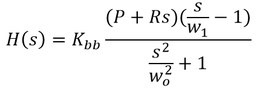
This transfer function is unstable and has a zero in the right-half-plane. To stabilize this system, a PD controller of the form (P+Rs) was introduced. A low P is chosen to reduce the DC gain and a well-placed wc determines the location of the second zero in order to improve the phase margin. This gives: w_c = P/R. Overall, this system becomes stable with the PD controller implemented.
MATLAB Simulation
MATLAB was the simulation tool used to build the system and the controller based on our test circuit. In this system, C = 100μF, L = 1mF, IL = 4A, Vin = 30V, and Vc = -120. For the PD controller, P = 2.946 x 10⁻⁵ and wc = 400 rad/s. This gave the following Bode Plot with a phase margin of 64° degrees, a stable system. This controller was implemented in the simulations for the circuits for this project.

