








 |
 |
 |
 |
 |
 |
 |
 |
 |
 |
Diffracted Beam Part consists of Diffracted Beam Optics and Detectors.
To see detailed overview, please click on items listed on the left.
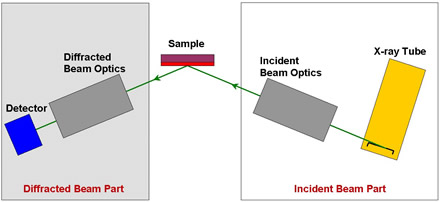

Diffracted Beam Optics
Diffracted Beam Slits

Receiving slits are placed in the diffraction beam path on the diffractometer circle. For parafocusing applications this position forms the focusing point of the diffracted x-ray beam.
Slits are supplied so that aperture be reduced to 1.2 mm, 0.75 mm, 0.45 mm or 0.2 mm. With no slit in place the aperture is 6 mm wide.
Triple Axis & Rocking Curve Option
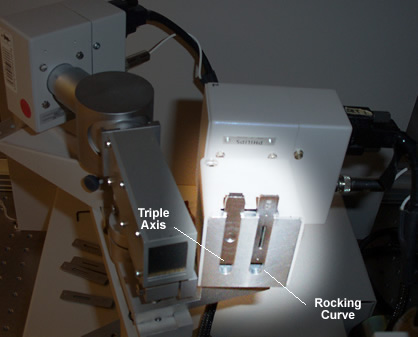
This option combines a triple axis and rocking curve paths designed for rocking curve (RC) measurements and reciprocal space mapping (RSM).
One path is Rocking Curve. There is a slit holder for mounting slits in front of the detector to reduce the beam acceptance angle. The slit holder has a 6 mm aperture.
Second path carries an analyzer crystal to convert the diffractometer to Triple Axis mode. The analyzer crystal is a channel cut Ge crystal. The diffracted beam undergoes two (220) reflections within the groove before entering the detector. The acceptance angle of the analyzer crystal is 12 arc sec.
The TA/RC attachment uses one detector - Detector 1.
Note:
A blank plate has to be inserted into the aperture that is not in
use.
Parallel Plate Collimator Option
This attachment combines parallel plate collimator and flat graphite monochromator.
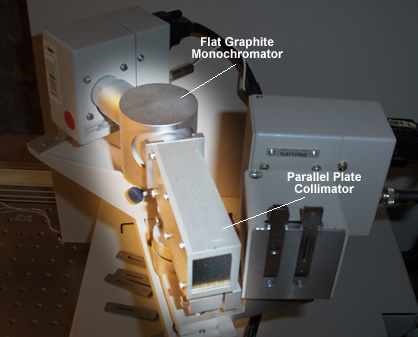
Diffracted beam collimator is an optical module used in the quasi-parallel beam geometry to define acceptance angle of the diffracted beam seen by the detector. The parallel plate collimator (PPC) consists of a set of parallel plates perpendicular to the diffraction plane. The distance between the plates defines the acceptance angle of the collimator. The collimator in the X-ray Lab has equatorial acceptance of 0.27o.

A collimator slit with an equatorial aperture of 0.1 mm can be mounted together with the PPC. This slit is mainly used for reflectivity measurements to enhance the resolution at very low 2q angles (< 4o).
Another part of the PPC Option is diffracted beam flat crystal monochromator. It is used to reduce the background radiation, eliminate Kb line and reduce the effect of sample fluorescence. The crystal used in the monochromator is a flat pyrolytic graphite crystal. The reflectivity for Cu Ka radiation is between 25% and 40%. The rocking width of the crystal is 0.4o.
Detectors
X-ray detector is used to count the number of photons (intensity) of the diffracted beam at certain 2q position of the goniometer. X'Pert diffractometer uses sealed proportional detectors - sealed chambers filled with xenon/methane gas mixture.

General properties of the Proportional Detector
| Window size | 20 X 24 mm2 |
| Efficiency Cu Ka | 84% |
| Efficiency Mo Ka | 36% |
| 99% Linearity range | 0 - 500,000 cps |
| Energy resolution around Cu Ka | 19% |
| Maximum count rate | 750,000 cps |
| Maximum background | 2 cps |
- The linearity range is defined as the range within
which the deviation from the linear relationship between the incoming
and counted x-ray photons is less than 1%.
- The energy resolution is determined by the ratio of the Full Width
at Half Maximum and the peak position of the pulse height distribution.
- The maximum count rate defines the maximum intensity of the x-ray
beam to which the detector may be exposed.