








 |
 |
 |
 |
 |
 |
 |
 |
 |
 |
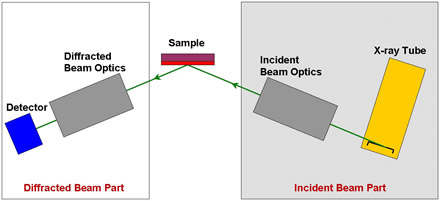
Incident Beam Part consists of X-ray Tube and Incident Beam Optics.
To see detailed overview, please click on items listed on the left.
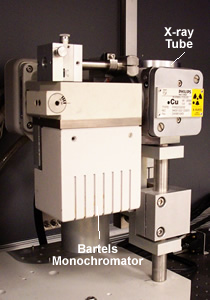
Incident Beam Optics
in High Resolution Position
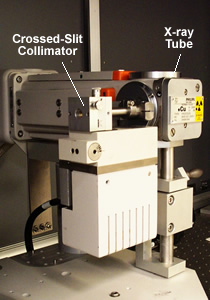
Incident Beam Optics
in Low Resolution Position
X-ray Tube
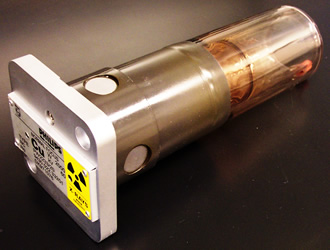
Glass diffraction x-ray tube
Main Properties
| Anode Material | Wavelength Ka1 (Å) | Wavelength Ka2 (Å) | Wavelength Ka (Å) |
| Cu | 1.54056 | 1.54439 | 1.54184 |
| Focus | Focus Type | Focus Dimensions | |
| Point | NF (Normal Focus) | 10 mm X 1.0 mm | |
| Be window diameter | Be window thickness | Working Power | |
| 14 mm | 300 mm | 45 kV / 30 mA |
Beta Filter
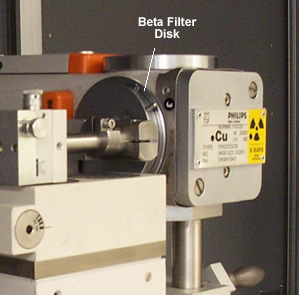
The primary b-filter is located in the primary b-filter disk mounted on the tube shield exit
Beta-filter
| Tube Anode | Beta-filter | Thickness (mm) | Kb intensity reduction (%) | Ka intensity reduction (%) |
| Cu | Ni | 15 | 98 | 48 |
Crossed Slit Collimator
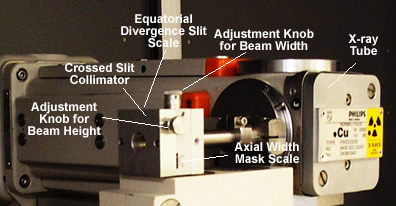
Crossed Slit Collimator (CSC) is usually used in a texture point focus experiments. The collimator acts like a divergence slit and a beam mask at the same time.
The crossed slits assembly consists of two manually adjustable orthogonal slits with a maximum size of 10 mm to define both axial and equatorial divergence of the x-ray beam emitted by the point focus of the x-ray tube.
The aperture on the crossed slits collimator is adjustable by means of two knobs: one vertical and one horizontal. The slits can be manually adjusted from 0 to 10 mm (the scales are marked 0.02 mm divisions). The adjustment accuracy is ± 0.02 mm.
Determination of the Irradiated Area
The size (length and width) of the area on the sample irradiated by the incident beam depends on the size of the x-ray beam and the position of the sample with respect to the beam. The irradiated length and width can be calculated as follows:
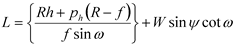
L = irradiated length on
the sample,
R = radius of the goniometer,
h = height of the incident beam, as set
by CSC,
ph = height of
the point focus (~ 1.2 mm),
f = distance from the x-ray tube focus
to the crossed slits,
y = tilt angle - angle between the sample
surface normal and the equatorial plane,
w = angle between the incident beam and
the sample surface.
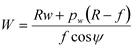
W = irradiated width on
the sample,
R = radius of the goniometer,
pw = width of
the point focus (~ 1.0 mm),
w = width of the incident beam, as set
by CSC,
f = distance from the x-ray tube focus
to the crossed slits,
y = tilt angle - angle between the sample
surface normal and the equatorial plane.
Bartels Monochromator
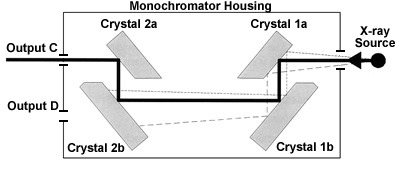
High resolution Bartels monochromator is based on the U-shaped blocks of single-crystal nearly perfect Ge. The crystals have (110) surfaces and are preset for the Ge(220) or (Ge440) Cu Ka1 reflections. The monochromator can be changed between 220 and 440 reflections by rotating U-shaped blocks. X-ray beam will emerge from the hole C. It is also possible to rotate the second block so that it does not intercept the beam from the first block. This is two crystal mode of the monochromator. In this mode the output beam exits though the aperture D in the monochromator housing.
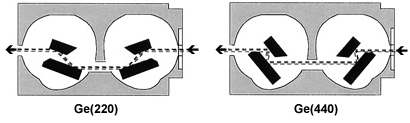
The wavelength spread is less than the natural line width of the CuKa1 line. The divergence of the beam exiting the housing is approximately equal to the width of the Darwin-Prins curve, which defines the angular range of the Bragg reflections that will occur in a perfect crystal. Each reflection at the crystal surfaces sharpens the flanks of the diffraction profile, thus giving a very low background intensity at angles only few sec away from the main peak.
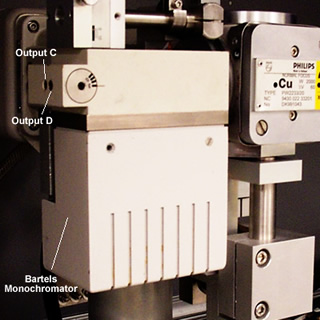
Characteristics of Bartels monochromator
| Mode | Focus type | FWHM | Relative intensity |
| 4 x Ge(220) | Point | 12" | 1 |
| 4 x Ge(440) | 5" | 0.08 | |
| 2 x Ge(220) | 600 | 3 | |
| 2 x Ge(440) | 250 | 0.3 |
Changing the incident beam optics
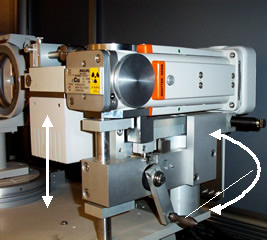
It is possible to change between using the crossed slit collimator and the Bartels monochromator in a few seconds. Rotate the handle of the interchange mechanism with your right hand whilst holding the shutter plate in position with your left hand. Make sure you have selected appropriate filter (i.e. "none" if you are using the monochromator). Gently guide the collimator/monochromator into the shutter aperture and press the collimator or monochromator and tube together.