| |
123. |
|
Convento dei Padri Eremiti di S. Agostino |
|
 |
|
 |
|
 |
|
| |
|
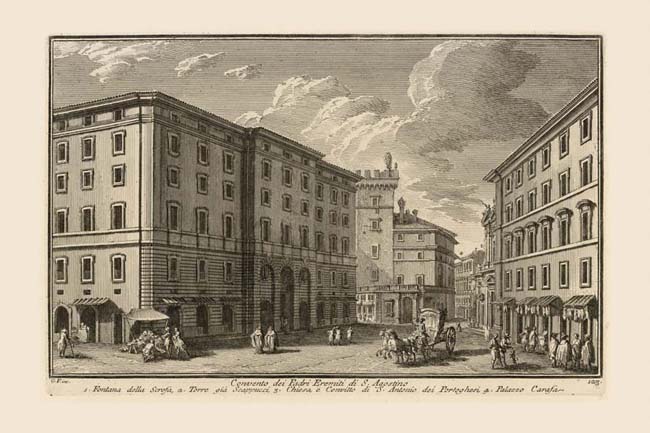
Convento dei Padri Eremiti di S. Agostino |
| |
1. |
Fontana della Scrofa |
| |
2. |
Torre già Scappucci |
| |
3. |
Chiesa ed Convitto di S. Antonio dei Portoghesi |
| |
4. |
Palazzo Carafa |
In order to reveal the side buildings, Vasi has widened Via dei Portoghesi to piazza size. The mid 18th century monastery of S. Agostino on the left, turns the corner onto Via della Scrofa denoted by the fountain which gives the street its name, the Fontana della Scrofa (1). The fountain, no longer running, shows the relief of a scrofa (sow). The contiguous view extends the scene to the right, showing the Via della Scrofa, Plate 107, continuing to the distant Piazza del Popolo. The medieval tower at the end of the Via dei Portoghesi, encased by the Renaissance Palazzo Scappucci (2) is known as the Torre della Scimmia (Monkey Tower) because of the legend of a miracle which occurred when a monkey carried a stolen baby to the top of the tower, but upon intervention of the Virgin, returned it unharmed to the weeping mother, who later set up the votive statue and lamp visible at the top of the tower. S. Antonio (3) the national church of the Portuguese, has a flamboyant Baroque facade topped by trumpeting angels, one of which appears outlined against the sky in the print. The street continuing beyond the church is the Via dell'Orso (named after the Hostelry of the Bear – Osteria dell'Orso). On this street Vasi picks out the distant Palazzo Carafa (4).
|
