| |
158. |
|
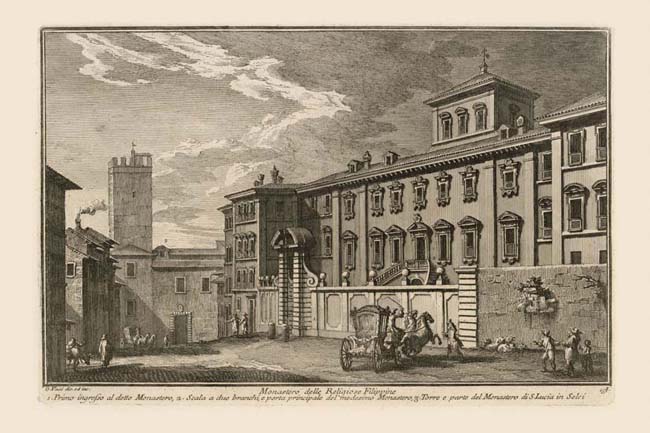
Monastero delle Religiose Filippine |
|
 |
|
 |
|
 |
|
| |
|
Monastero delle Religiose Filippine |
| |
1. |
Primo ingresso al detto Monastero |
| |
2. |
Scala a due branchi e porta principale del medesimo Monastero |
| |
3. |
Torre e parte del Monastero di S. Lucia in Selci |
The Filippines were dedicated to the memory of the Counter Reformation saint Filippo Neri, whose main church and monastery is S. Maria in Vallicella, Plate 137, commonly known as the Chiesa Nuova. In this print, the impressive façade of the monastic complex with elaborate curved double stair (2), corner pavilions and tall entrance gate (1) does not look like the type of humble convent that the austere saint would have approved. That is because it was originally built in the early 18th century as the suburban villa of the Sforza family. In the print the street along the right side of the building is still named Via Sforza (NN 160). The villa was taken over by the Filippine nuns in about 1740. At the end of Via dei Quattro Cantoni on which the monastery faces, we see that part of the convent of S. Lucia in Selci (3) Plate 143,which was demolished in the late 19th century to make way for Via Giovanni Lanza. Behind it is the same medieval tower of the Capocci visible in Plate 155.
|
