| |
159. |
|
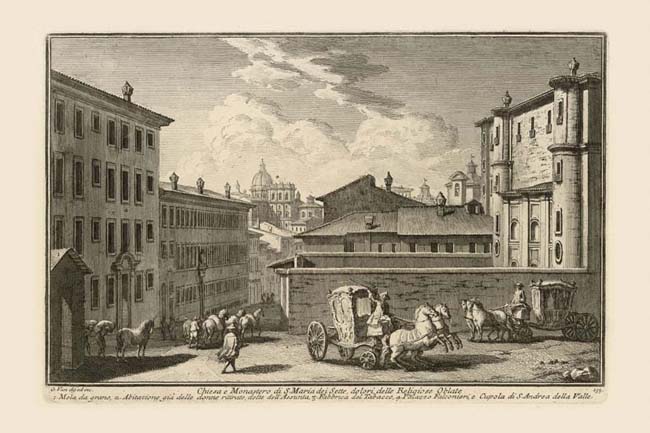
Chiesa e Monastero di S. Maria dei Sette, dolori, delle Religiose Oblate |
|
 |
|
 |
|
 |
|
| |
|
Chiesa e Monastero di S. Maria dei Sette dolori, delle Religiose Oblate |
| |
1. |
Mola da Grano |
| |
2. |
Abitazione delle donne ritirate dette dell'Assunta |
| |
3. |
Fabbrica del Tabacco |
| |
4. |
Palazzo Falconieri e Cupola di S. Andrea della Valle |
On the right Vasi depicts the unusual facade of S. Maria dei Sette dolori, begun by Borromini in the 1640s but left unfinished in its top section. Its forecourt and the houses next to it cause a bottleneck in the long Piazza delle Fornaci, now part of Via Garibaldi. In the foreground there is an interesting contrast between the carriages of the nobility and the workers with their horses leaving the grain mill (1) on the far left. This mill was run by water channeled down from the Acqua Paola fountain some 40 meters higher up on the Janiculum hill. On the left the Conservatorio dell' Assunta (2) a rest home for older women, is followed by the mid 18th century tobacco factory (3). The Nolli map shows that both of these buildings align with a stretch of the Aurelian walls. On the horizon to the right, seen peeping above the roof of the houses next to S. Maria, are (from left to right) the right corner of the back facade of Palazzo Farnese, Plate 73, the bell and clock tower of Palazzo Montecitorio, Plate 23, and the church of S. Maria della Scala (NN 1199) in Trastevere. In the distance above the street to the left Vasi illustrates the Borromini altana (tower belvedere) of Palazzo Falconieri (4), and to its left the dome of S. Andrea della Valle, Plate 134. Nearer and to the right of Palazzo Falconieri rises the cylindrical dome of S. Dorotea designed by Nolli shortly before his death in 1756 and where the great cartographer is buried. On his map Nolli marks the site of the old church which his replaced (NN 1206).
|
