| |
164a. |
|
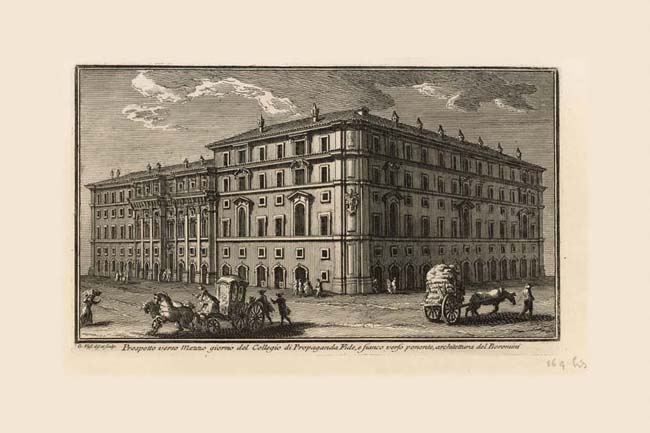
Prospetto verso Mezzo giorno del Collegio di Propaganda Fide, e fianco verso ponente, architettura del Boromini |
|
 |
|
 |
|
 |
|
| |
|
Prospetto verso Mezzo giorno del Collegia di Propaganda Fide, e fianco verso ponente |
Vasi represents the Collegio della Propaganda Fide in three different plates (see Plates 40, 146). In this print of the Collegio (Congregation for the Propagation of the Faith) Vasi uncharacteristically depicts a building entirely isolated from its urban context, surrounded by wide spaces which do not exist in actuality. Except for the facade around the left corner of the block by Bernini, Plate 40, the remainder of the building was designed by Borromini. Its building history can be traced by reading the papal insignia present in its different parts. Bees (not visible in the print) on the keystones of the arched doorways on the right hand (shaded) facade attest to that part belonging to the pontificate of Urban VIII Barberini (1623-1644). Acorns on the next two levels and the large coat-of-arms on the corner (now gone) indicate construction under Alexander VII Chigi (1665-1667). Vasi shows six hills on the top floor rounded corner, but actually there are only three hills, which together with the horizontal band and a star above it indicates that the completion occurred under Clement XI Albani (1700-1721). The main entrance to the building is visible on the left where two figures are seen entering a tall rectangular doorway recessed in the concave central bay of a slightly projecting seven bay unit. The contiguous print, Plate 146, shows a portion of the Collegio as it faces S. Andrea alle Fratte.
|
