| |
173. |
|
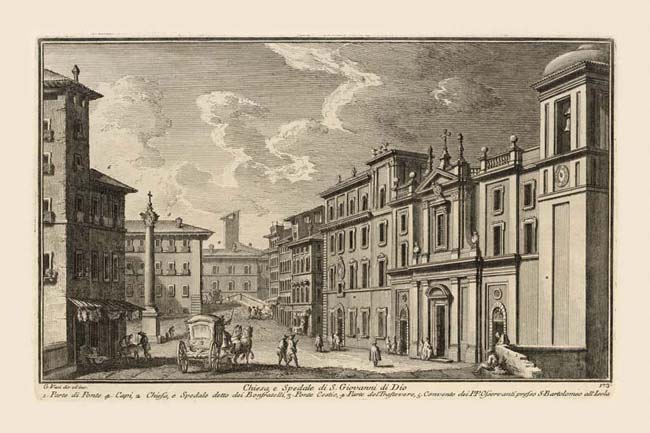
Chiesa, e Spedale di S. Giovanni di Dio |
|
 |
|
 |
|
 |
|
| |
|
Chiesa di S. Giovanni di Dio |
| |
1. |
Parte di Ponte 4 Capi |
| |
2. |
Chiesa e Spedale detto dei Bonfratelli |
| |
3. |
Ponte Cestio |
| |
4. |
Parte del Trastevere |
| |
5. |
Convento dei PP.Osservanti di S.Bartolomeo all'Isola |
Vasi provides several external views of the Isola Tiberina which emphasize its relationship to the Tiber (see particularly Plates 91, 93). This print of the Isola Tiberina, however, focuses on its central urban space and complements a companion view entitled Chiesa di S. Bartolomeo all'Isola, Plate 92. In this view we are looking toward Ponte Cestio (3) and some distant buildings in Trastevere (4). S. Bartolomeo is not visible, being off to the left, but Vasi gives considerable emphasis to the column in front of it, which in reality would not be visible from this point of view because it was located further back in the piazza. Nolli uncharacteristically represents the column by a quincunx (the five dot symbol) which is usually reserved to depict an open drain. The column was replaced by a statue grouping under Pius IX Mastai-Ferretti (1846-1878). The Franciscan monastery (5) building beyond the column, as well as the three buildings to the right of the bridge were demolished in the late 19th century during the building of the river walls when the Ponte Cestio was largely rebuilt. On the right we see the early 18th century facade of S. Giovanni Calabita encapsulated in the hospital of Fatebenefratelli (2) which was rebuilt in 1584 by S. Giovanni di Dio (hence the title of the print). Partly rebuilt in 1930, it remains one of Rome's major hospitals to this day. In the lower right hand corner Vasi depicts the beginning of the Ponte Fabricio (1).
|
