| |
172. |
|
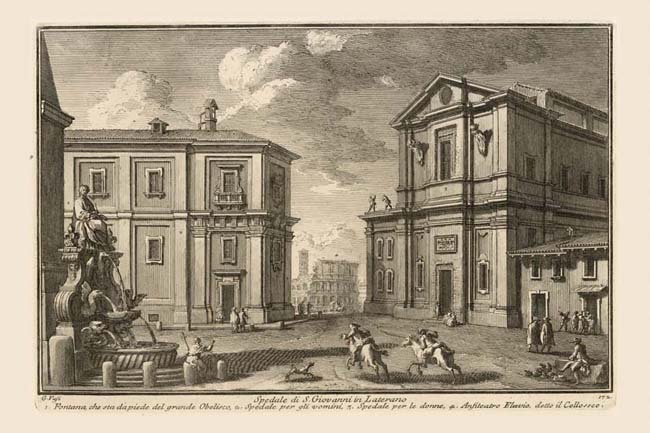
Spedale di S. Giovanni in Laterano |
|
 |
|
 |
|
 |
|
| |
1. |
Fontana che sta da piede del grande Obelisco |
| |
2. |
Spedale per gli uomini |
| |
3. |
Spedale per le donne |
| |
4. |
Anfiteatro Flavio detto il Collosseo |
This is one of three contiguous views of Piazza S. Giovanni in Laterano (see Plates 34, 101) which collectively render a virtual panorama of Rome's cathedral square on its northern face. All three depict its obelisk and base fountain (1) while the same selected features are shown from different vantage points. In this view Vasi frames the opening of the Via S. Giovanni in Laterano axis from the Lateran obelisk to the Colosseum (4), Plate 33, which is telescoped to look much nearer in this print than in reality. This street was one of Sixtus V's 1580s system of rectilinear urban connections cut through the sparsely populated Rioni Monti and Campitelli. It constituted the terminal section of the Via Papale, the processional route linking the Lateran to the Vatican. Rising above the Colosseum in the distance is the tall bell tower of S. Francesca Romana, Plate 32, in the Roman Forum. The two distinct wings of the hospital of S. Giovanni were built in the mid 17th century, the men's ward (2) on the left and the women's ward (3) on the right. This setup differed from the standard Roman hospital type where the two wards radiate from a central chapel, as occurs in the hospitals of S. Spirito, Plate 171 and S. Gallicano, Plate 174, which are featured in this volume. At left the fountain at the foot of the obelisk appears in a different form from the same fountain in another Vasi print of the Piazza S. Giovanni, Plate 101. In the latter, which also depicts part of the men's ward of the hospital, the papal arms of Paul V Borghese (1605-1621) surmount a single jet of water which falls into a semi-circular basin. In the present view an eagle replaces the coat-of-arms and is flanked by two dragons. An intermediate basin collects the water spouting from these three figures and lets it fall into the semi-circular basin. The seated figure of St. John the Evangelist appears in both prints, but the stylized lilies which flank him in this print are not present in the other. Since the eagle and dragon are part of Paul V's crest, they would seem to date from the period of his papacy. This poses the question as to why Vasi did not depict them in the other print. A possible explanation is that since the fountain plays so small a part in that image, Vasi may have drawn it in simplified form.
|
