| |
101. |
|
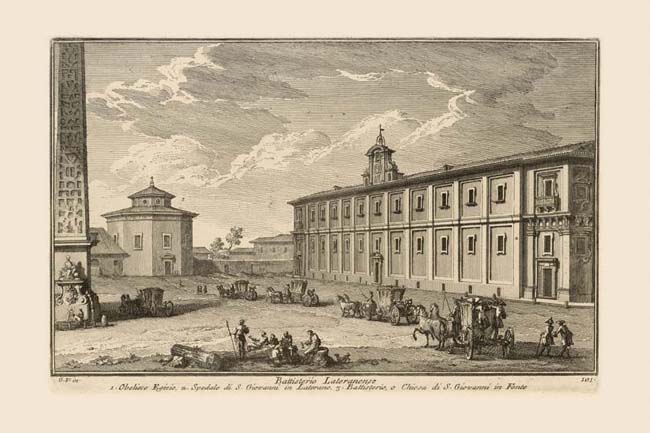
Battisterio Lateranense |
|
 |
|
 |
|
 |
|
| |
1. |
Obelisco Egizio |
| |
2. |
Spedale di S. Giovanni in Laterano |
| |
3. |
Battisterio o Chiesa di S. Giovanni in Fonte |
This print illustrates the western edge of this vast urban space and is one of three contiguous views of Piazza di S. Giovanni in Laterano, Plates 34, 172. The ostensible subject of this view is the octagonal Lateran Baptistry, S. Giovanni in Fonte (3) first built under the emperor Constantine (306-337), restructured by Sixtus III (432-440) and restored by Borromini under Urban VIII Barberini (1623-44). The obelisk (1) was found in three pieces in the Circus Maximus, Plate 60A, and mounted here by Domenico Fontana in 1588. The fountain at its foot was built under Paul V Borghese (1605-21), whose coat-of-arms can barely be made out on the print: an eagle above a dragon. In the first half of the 19th century that coat-of-arms was replaced by a simple pair of crossed keys (traditional symbol of the Popes) flanked by two dragons and topped by an eagle. The Nolli map indicates the positioning of the Lateran obelisk to be at the intersection of the street axes of Via Merulana (formerly Via Gregoriana) and Via di S. Giovanni in Laterano. Sixtus V Peretti (1585-1590) completed the former street and built the latter ex novo, as part of his radial urban scheme centering on S. Maria Maggiore, Plates 48, 122, providing access to the major churches in this relatively uninhabited part of the city. Via di S. Giovanni Laterano was the end of the Via Papale (the papal processional route) and can be seen entering the piazza at the extreme right edge of this print, partially blocked by the corner of the Hospital of S. Giovanni (2) built in the 1630s. At the left end of the hospital, another Sixtus V street leaves the piazza heading to the right, in the direction of St. Paul's outside the walls. Although schematic, the Bordino map, which is contemporary with Sixtus V, shows a straight line connecting the two basilicas along this path.
|
