| |
186. |
|
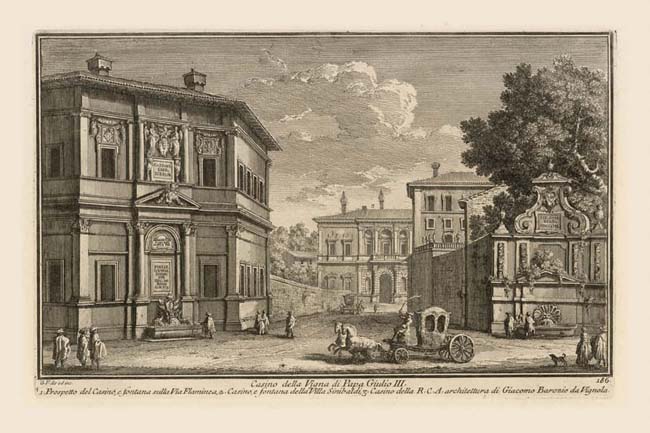
Casino della Vigna di Papa Giulio III |
|
 |
|
 |
|
 |
|
| |
1. |
Prospetto del Casino e fontana sulla Via Flaminia |
| |
2. |
Casino e fontana della Villa Sinibaldi |
| |
3. |
Casino della R.C.A. architettura di Giacomo Barozio da Vignola |
Vasi refers to this suburban villa as a vigna (vineyard or farm) because it was built by Pope Julius III Ciocchi del Monte (1550-1555) on a family property along the Via Flaminia known as the Vigna Vecchia (old farm). Located outside the Aurelian walls but within range of the Porta del Popolo, Plate 1, the Villa Papa Giulia was used as a staging point for dignitaries before their grand entry through the same gate into the Piazza del Popolo, Plates 21, 21A, the urban vestibule into the city from the north. When the Villa Papa Giulia was built, none of the other buildings in this view existed. The exception is the fountain on the left (1) which was constructed at the same time as the villa. Its angled position with respect to the Via Flaminia in the foreground served as an invitation to the dedicated street, Via di Villa Giulia, leading to the main door of the distant casino (3) designed by Vignola. In the print this street appears to be on the central axis of the casino, whereas it actually forms a 30° angle with that axis. The design of the extensive Villa Giulia (3) (now Rome's Etruscan museum) involved several architects including Vasari, Ammanati, and as Vasi’s notes, Vignola. Not long after the completion of the villa, Pius IV Medici (1559-1565) encapsulated the fountain (1) with the foreground building on the left designed by Ligorio, and gave it to his nephew Carlo Borromeo (later canonized a saint). Borromeo's name appears in an inscription below the Medici arms of Pius IV at the second level. Two additional inscriptions on the ground level continue the historical account. The one directly above the fountain refers to Filippo Colonna who owned the building in the mid 17th century. The one directly above that indicates that water was restored to the fountain under Benedict XIV Lambertini (1740-1758). Cardinal Federico Borromeo built the companion fountain across the way in 1672 as its inscription relates. This became part of the villa acquired by the Sinibaldi in 1702 whose casino (2) appears in the middle ground. The fountain was destroyed in the early 20th century, and replaced by a smaller one at mid century.
|
