| |
187. |
|
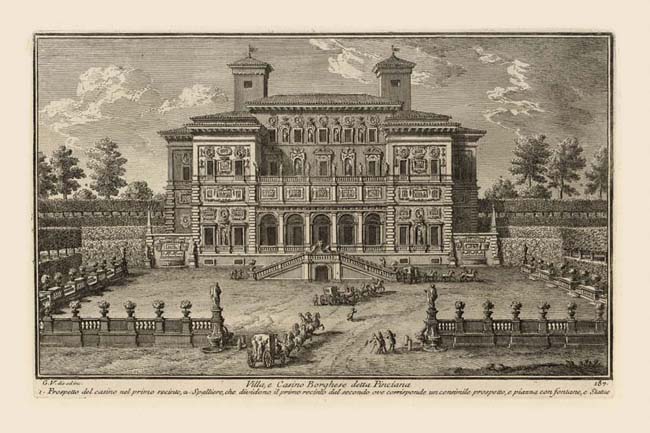
Villa, e Casino Borghese detta Pinciana |
|
 |
|
 |
|
 |
|
| |
1. |
Prospetto del casino nel primo recinto |
| |
2. |
Spalliere che dividono il primo recinto dal secondo ove corrisponde un con- simile prospetto |
Soon after his uncle was elected Pope Paul V (1605-1621), Scipione Borghese built the Villa Borghese (1). With some justification the Neoclassic sculptor Antonio Canova referred to this as the most beautiful villa in the world. The site chosen was a family plot just outside the Aurelian walls, near Porta Pinciana, Plate 2. Gradually the cardinal acquired more land which made this the most extensive villa in Rome at the time. The plan of the casino, designed by Flaminio Ponzio, consists of two projecting wings joined by an arched portico with lateral espaliered garden walls (2) separating the entry court from the rear fontain. In its basic form casino recalls that of the Villa Farnesina, Plate 88A, built a century earlier by Agostino Chigi. The casino and a considerable portion of the villa's gardens appear on the Nolli map, which shows the main entrance to the grounds to be located near the sharp angle in the Aurelian walls known as the Muro Torto, Plate 1A. The distance from Palazzo Borghese, Plate 69, to this gate about equaled the distance from the gate to the casino. Thus the family could drive from their city residence to the gate of their suburban villa in a matter of minutes, and then cross the pleasant park of their villa from one end to the other, finally arriving at the casino, as the three carriages in this view seem to be doing. The law of the gardens (see Plate 188) enabled the city to expropriate the villa in 1901 and turn it into a public park.
|
