Object Name:
Rattle
Object ID:
60.260
Dimensions:
H–5.7 W–11.2 L–33.2 cm
Place of origin:
South America; Brazil; Araguaia River region; Ilha do Bananal
Material(s):
Wood/Vegetal/Bone/Tar/Feather/String
Collection:
Anthropology; South America
Case:
A Turtle Shell Rattle
In northeast Brazil, the Araguaia River splits into two forks at the middle of its course that reunite downstream to form the Ilha do Bananal, the world's largest river island. This region's high value within Brazilian Amazonian ecology means that, as well as being one of the most biologically rich areas of the eastern Amazon, it has been–and is–home to many human cultural groups. One such group is the Karajá people.
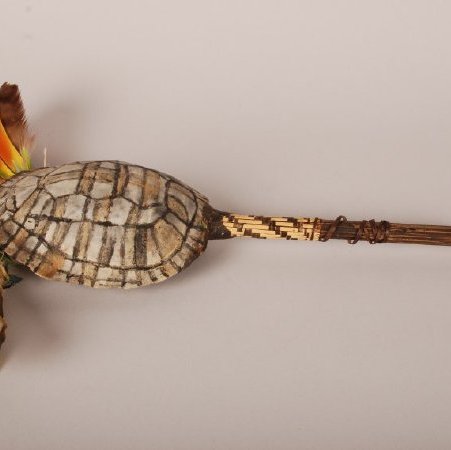
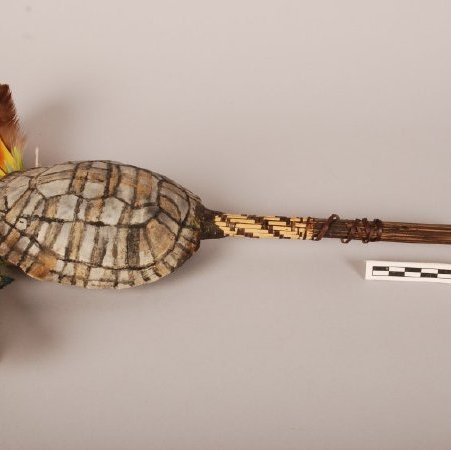
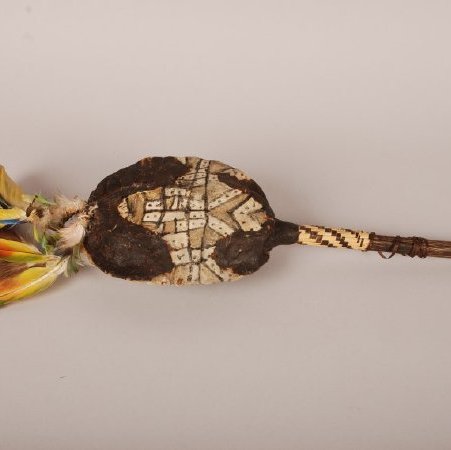
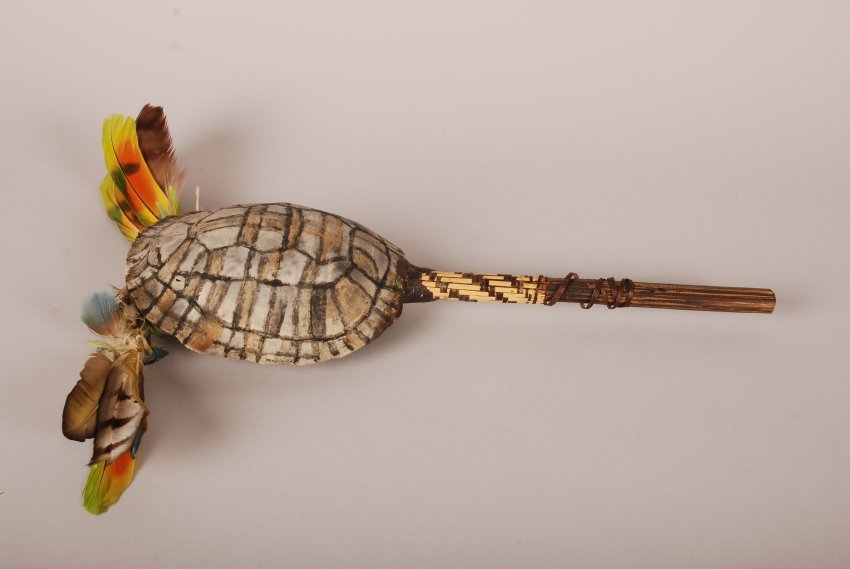
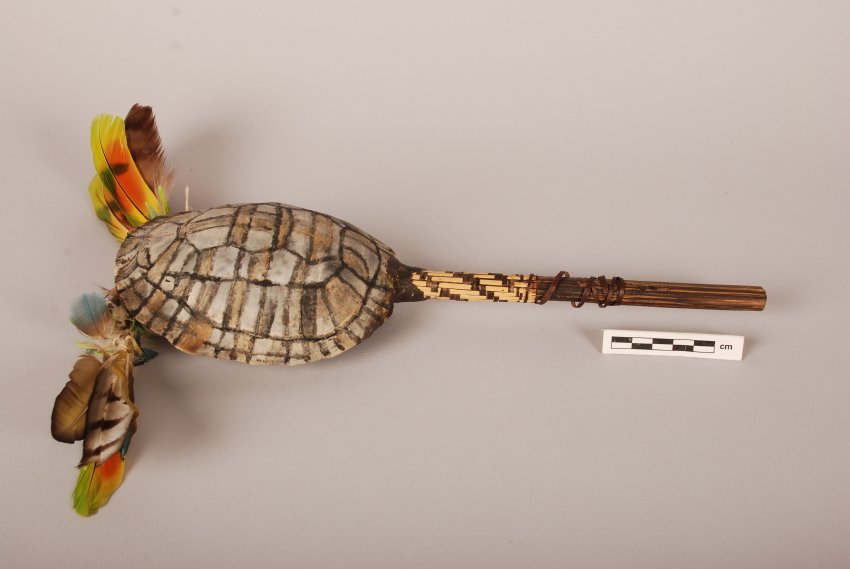
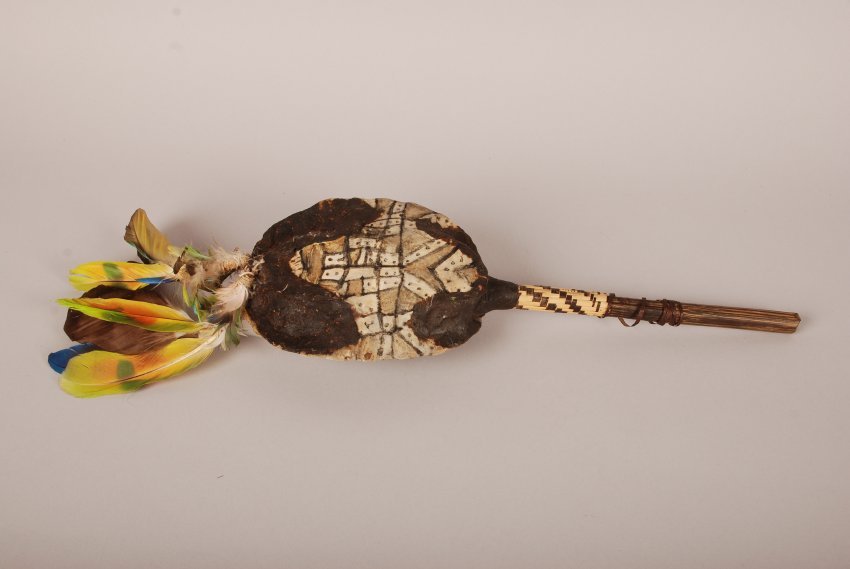
The Karajá are an indigenous tribe that in the 20th century numbered approximately 45,000. Today, their numbers have dwindled to approximately 3500 due to violent historical encounters with Europeans. Their society is built upon a self–sufficient hunter–gatherer structure. They are also the makers of an object donated by Charles A. Wilhelmson to Stanford University's archaeological collections in 1960: a feathered rattle (Object ID 60.260) that, even at first glance, is remarkable. Its shape is delicate–fitting due to its ceremonial use by high–status Karajá when celebrating local mythology during dry season festivals. A large turtle shell makes up the body, glinting pale blue, gray, and yellow between black outlines of its plates. It is carried via a wooden handle decorated with a checkered pattern of woven rattan. Most strikingly, the top end of the artefact sprouts large feathered tassels of vibrant yellow, orange, blue, green, and brown.
The fact that Karajá of circa 1960 were able to access and use feathers of such magnificence is not a surprise. The Ilha do Bananal houses over seven hundred species of birds, "Araguaia" translates to "River of the Macaws" in the native Tupi language, and the Karajá are known for excelling at featherwork. However, what is less obvious to outsiders is the significance placed upon such feathers in the culture of the Karajá and its subsequent impact upon their hierarchies and interpersonal interactions.
Colorful feathers, such as those used in this rattle, have long been associated with prestige in Karajá culture. This is partly due to the Brazilian Amazon's dense ecological system. Because of the constant rain and flood in this region, soil on forest floors is poor in nutrients. Trees must grow to extreme heights to compete for sunlight, creating a hierarchy of growth: the canopy, the middle growth, and the ground level. This adaptation lends itself to an additional hierarchy in bird species. The beautiful, rare birds from the canopy and middle growth, such as the Karajá's favored scarlet macaw and harpy eagle, possess the largest and most vibrant feathers. Their high position in the Amazon's natural hierarchy is thus reflected symbolically in their frequent use in Karajá featherwork.
The association of these feathers with status and the nature of their subsequent use is tied closely to cultural norms and ideals of strength in Karajá culture. Men, with their perceived virile strength and position as hunters, are associated with birds of higher prestige from the rainforest canopy. They are the only ones who wear the most sought–after feathers, such as those of the harpy eagle, a bird of prey from the uppermost level of the rainforest. Women, on the other hand, garden and gather and are associated with birds of lower levels. Thus emerges yet another hierarchy, one cultural rather than natural: due to the high position of men in Karajá society, only male objects or apparel are decorated with feathers from middle– and high–strata birds or decorated with feathers at all. Women's clothing is rarely feathered, and when it is, those used are from the curassow, a bird which lives on the forest floor.
Observing the art of featherworking through this turtle shell rattle allows us to reach significant conclusions on the Karajá, their values, and their social structure. It speaks to this culture that the most prized feathers are used only in the creation of male attire. Even by examining the only other known Karajá item in the Stanford University Archaeology Collection, the dominance of males in their society is obvious. It is a small wooden labret with orange and yellow feathers attached to one end, worn as a lower lip plug to indicate a man in the "prime of his life." It is certain that as this object was intended for a male user, as was the rattle.
By investigating the reasons for the use of feathers and the purpose of the produced items, we are able to understand the importance of hierarchy and prestige and their structural reflections in Karajá society. The use of feathers as symbolic items makes evident their societal values of physical strength, virility, and masculinity, their measures of beauty, as well as their respect towards natural systems and hierarchies. Thus, the Karajá's desire to become or seem alike to dominating animals of high strata reveals much about the way they view both their individual and cultural place in Amazonian Brazilian environment and ecology.
––– Annie Ng
References Cited
"Karajá Ijasò Mask & Rattles – Infinity Of Nations: Art And History In The Collections Of The National Museum Of The American Indian". National Museum of the American Indian. Web. 3 May 2017.
"Rattle | Smithsonian Institution". Smithsonian Institution. N.p., 2017. Web. 3 May 2017.
Reina, Ruben E, and Kenneth M Kensinger. The Gift Of Birds: Featherwork Of Native South American Peoples. 1st ed. Philadelphia, PA: University Museum of Archaeology and Anthropology, University of Pennsylvania, 1991. Print.
In northeast Brazil, the Araguaia River splits into two forks at the middle of its course that reunite downstream to form the Ilha do Bananal, the world's largest river island. This region's high value within Brazilian Amazonian ecology means that, as well as being one of the most biologically rich areas of the eastern Amazon, it has been–and is–home to many human cultural groups. One such group is the Karajá people.
The Karajá are an indigenous tribe that in the 20th century numbered approximately 45,000. Today, their numbers have dwindled to approximately 3500 due to violent historical encounters with Europeans. Their society is built upon a self–sufficient hunter–gatherer structure. They are also the makers of an object donated by Charles A. Wilhelmson to Stanford University's archaeological collections in 1960: a feathered rattle (Object ID 60.260) that, even at first glance, is remarkable. Its shape is delicate–fitting due to its ceremonial use by high–status Karajá when celebrating local mythology during dry season festivals. A large turtle shell makes up the body, glinting pale blue, gray, and yellow between black outlines of its plates. It is carried via a wooden handle decorated with a checkered pattern of woven rattan. Most strikingly, the top end of the artefact sprouts large feathered tassels of vibrant yellow, orange, blue, green, and brown.
The fact that Karajá of circa 1960 were able to access and use feathers of such magnificence is not a surprise. The Ilha do Bananal houses over seven hundred species of birds, "Araguaia" translates to "River of the Macaws" in the native Tupi language, and the Karajá are known for excelling at featherwork. However, what is less obvious to outsiders is the significance placed upon such feathers in the culture of the Karajá and its subsequent impact upon their hierarchies and interpersonal interactions.
Colorful feathers, such as those used in this rattle, have long been associated with prestige in Karajá culture. This is partly due to the Brazilian Amazon's dense ecological system. Because of the constant rain and flood in this region, soil on forest floors is poor in nutrients. Trees must grow to extreme heights to compete for sunlight, creating a hierarchy of growth: the canopy, the middle growth, and the ground level. This adaptation lends itself to an additional hierarchy in bird species. The beautiful, rare birds from the canopy and middle growth, such as the Karajá's favored scarlet macaw and harpy eagle, possess the largest and most vibrant feathers. Their high position in the Amazon's natural hierarchy is thus reflected symbolically in their frequent use in Karajá featherwork.
The association of these feathers with status and the nature of their subsequent use is tied closely to cultural norms and ideals of strength in Karajá culture. Men, with their perceived virile strength and position as hunters, are associated with birds of higher prestige from the rainforest canopy. They are the only ones who wear the most sought–after feathers, such as those of the harpy eagle, a bird of prey from the uppermost level of the rainforest. Women, on the other hand, garden and gather and are associated with birds of lower levels. Thus emerges yet another hierarchy, one cultural rather than natural: due to the high position of men in Karajá society, only male objects or apparel are decorated with feathers from middle– and high–strata birds or decorated with feathers at all. Women's clothing is rarely feathered, and when it is, those used are from the curassow, a bird which lives on the forest floor.
Observing the art of featherworking through this turtle shell rattle allows us to reach significant conclusions on the Karajá, their values, and their social structure. It speaks to this culture that the most prized feathers are used only in the creation of male attire. Even by examining the only other known Karajá item in the Stanford University Archaeology Collection, the dominance of males in their society is obvious. It is a small wooden labret with orange and yellow feathers attached to one end, worn as a lower lip plug to indicate a man in the "prime of his life." It is certain that as this object was intended for a male user, as was the rattle.
By investigating the reasons for the use of feathers and the purpose of the produced items, we are able to understand the importance of hierarchy and prestige and their structural reflections in Karajá society. The use of feathers as symbolic items makes evident their societal values of physical strength, virility, and masculinity, their measures of beauty, as well as their respect towards natural systems and hierarchies. Thus, the Karajá's desire to become or seem alike to dominating animals of high strata reveals much about the way they view both their individual and cultural place in Amazonian Brazilian environment and ecology.
––– Annie Ng
References Cited
"Karajá Ijasò Mask & Rattles – Infinity Of Nations: Art And History In The Collections Of The National Museum Of The American Indian". National Museum of the American Indian. Web. 3 May 2017.
"Rattle | Smithsonian Institution". Smithsonian Institution. N.p., 2017. Web. 3 May 2017.
Reina, Ruben E, and Kenneth M Kensinger. The Gift Of Birds: Featherwork Of Native South American Peoples. 1st ed. Philadelphia, PA: University Museum of Archaeology and Anthropology, University of Pennsylvania, 1991. Print.
Date:
AD 1673–1960
Provenance:
Donated by Charles A. Wilhelmson to Stanford University in 1960. A letter written by Charles A. Wilhelmson, dated 05/09/1966, suggests that the objects he donated to Stanford were collected by missionary relatives.
Click to Enlarge