
Object Name:
Spoon
Object ID:
8607
Dimensions:
H–2.8 W–9.2 L–36.4 cm
Place of origin:
North America; Canada; British Columbia; Haida Gwaii (Queen Charlotte Islan
Material(s):
Horn/Abalone
Collection:
Anthropology; North America; Northwest
Case:
A Haida Potlatch Ladle
When I was growing up, my family lived down the street from a small chain restaurant called Boston Market. With a menu consisting mostly of roasted chicken, mashed potatoes, green beans, and other generic Thanksgiving–esque staples, there was very little setting Boston Market apart from any other traditionally "American" eatery, except perhaps for the cheap prices that drew us there in the first place. Yet many years later, one particular aspect of the Boston Market dining experience sticks in my memory despite every other part being emphatically forgettable: the chain's unique insistence on providing only sporks, rather than forks, spoons, and other utensils, to its customers. In my mind, these bizarre half–spoon half–fork hybrids are now inextricably linked to what can only be described as the Boston Market "culture" – mass–produced, blandly utilitarian, and decent at everything but excellent at nothing.
I attribute my present fascination with the anthropology of utensils to the memories I have of those sporks, strange and wonderful and perfectly representative of a specific time and place. More broadly, however, utensils provide an excellent window into culture because they are one means by which we as humans most directly engage with the politics of resource consumption. Textiles and plastics and metals are processed in far–away factories, energy use is mediated through unknowable technologies, but utensils literally bring food to our mouths. The consumption of resources, and thus the means by which they are allocated and depleted, is immediately, viscerally, tastily tangible.
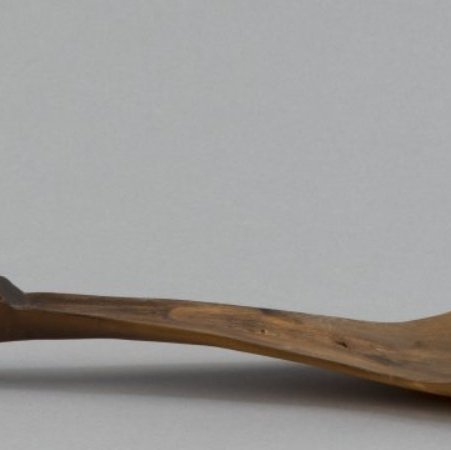
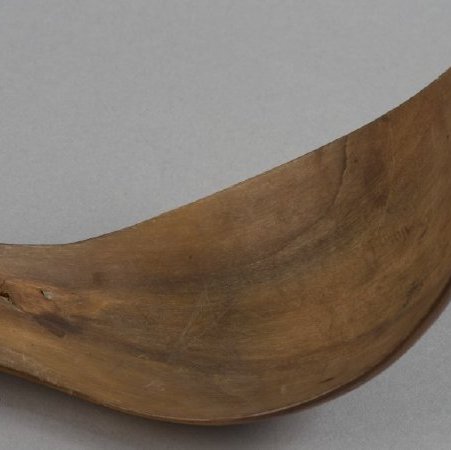
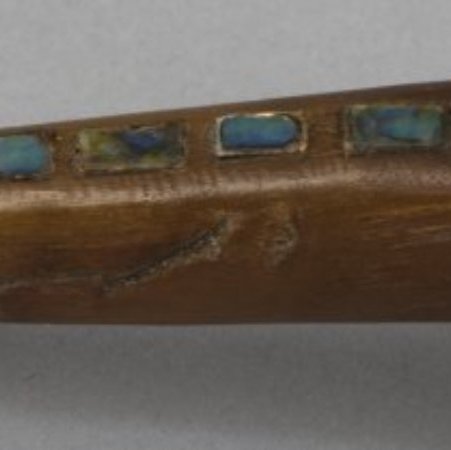
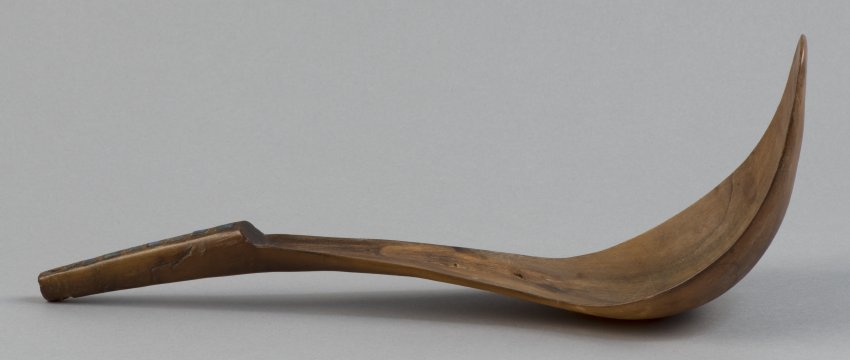
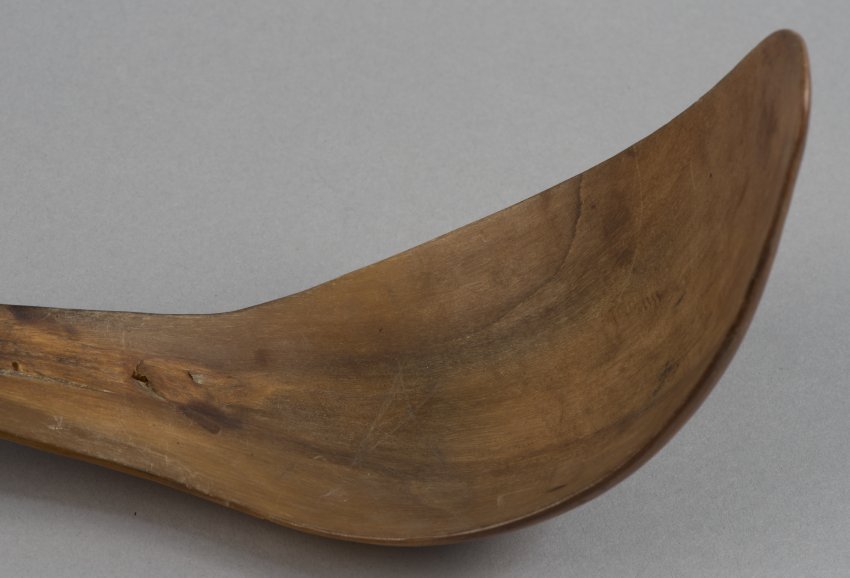
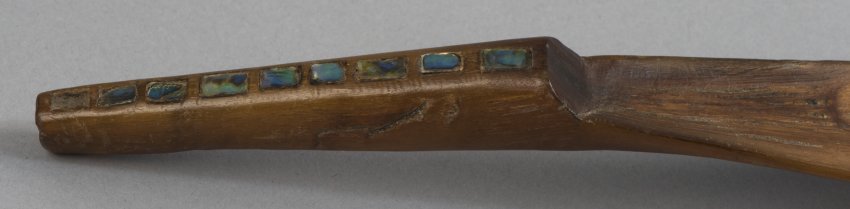
Case in point: Object ID 8607 in the Stanford Archaeology Collections, a large spoon from the Haida Indians of the Queen Charlotte Islands off Canada's northwest coast likely dating from the late 19th or early 20th century. Carved from a single piece of sturdy horn and inlaid with glistening abalone shells in the handle, this massive ladle stretches the length of a forearm and curves gracefully from its tapered back to its broad frontal bowl with an outline like that of a hooded cobra. Far too big for an individual to eat with, the physicality of the utensil reveals a communal serving purpose; in particular, use in the Haida's famous potlatch feast–ceremonies seems very likely.
Just as the Boston Market spork only has symbolic meaning to someone familiar with the ethos of the corporate culture that produced it, the ethnographic implications of the Haida ladle can only be appreciated as contextualized by the particularities of Haida life. For over 8,000 years, the Haida have called the Queen Charlotte Islands and surrounding regions home, acting as stewards of the lands off of which they have sustained themselves. They have a clan–based kinship system that emphasizes the transfer of goods as a way to define relationships and identify one's status in relation to material wealth. Though caricatures of Native Americans sometimes imply egalitarianism, the Haida's historically complex networks of trade, charity, and reciprocity formed hierarchical systems.
The potlatch remains a highly formalized celebration that emphasizes gift–giving by the host to guests. This system of individual wealth redistribution, which historically marked key events like puberty or death, was meant to emphasize the high social rank of the host who gave away their property to the attendants. The implication was that they were so rich and powerful that they could easily acquire more as needed. Potlatches were explicitly tied to economics, as exemplified by increases in the quantity of gifts, number of guests, and frequency of occurrences following the Haida's 19th–century enrichment from trade with Euro–American settlers. It is out of the potlatch context that the ladle in question likely emerged. An important status symbol, it was probably used to serve food to attendees or (less likely given the lack of stains on the basin) to apportion ritual oils.
The culture embedded in the materiality of the spoon, then, is one that co–mingles private property and communal sharing in a way that seems foreign to a modern Western conception of resource consumption, wherein a strict rhetorical dichotomy exists between capitalist and socialist models. But perhaps the notion of potlatch gift–giving should not seem so odd.
For the Haida who made this utensil, generosity was a status symbol; the ability to give away material wealth served to reaffirm one's supremacy as a powerful consumer of that same wealth. This dynamic is evident in our own 21st–century American culture, too. A 2007 study, for instance, suggested an evolutionary basis for charitable giving as a mating device meant to demonstrate the ability to provide material support for a partner. And one need only look at that Western emblem of wealth, the iconically selfless Bill Gates, to notice a cultural demarcation of charity as class signifier. The public nature of the Haida potlatch, as well as the often ostentatious nature of modern fiscal altruism, embodies what one could think of as "conspicuous charity." Just like conspicuous consumption, conspicuous charity is a status symbol and an indicator of wealth and power.
Just as the Boston Market spork is inextricably a product of a distinct ethos and its materiality cannot be appreciated without that context, the Haida spoon can only be understood within the larger narrative of Haida culture and economics. The potlatches in which it was likely used reveal a cultural emphasis on sharing as emblematic of wealth, shedding light on why a ladle – inherently an implement of charity, a public rather than private utensil that the owner uses to feed others rather than just themselves – would be afforded such a place of respect in Haida material taxonomy. Eating from the ladle might nourish the body, but holding it feeds prestige.
––– Brian Contreras
References Cited
Blackman, Margaret B. "Ethnohistoric Changes in the Haida Potlatch Complex." Arctic Anthropology 14, no. 1 (1977): 39–53. http://www.jstor.org/stable/40315896. Accessed 3 May 2017. Web.
Blatant benevolence and conspicuous consumption. The Economist. 2 August 2007. https://www.economist.com/node/9581656. Accessed 3 May 2017. Web.
Haida Gwaii. Cultural History. http://www.gohaidagwaii.ca/our–islands/cultural–history. Accessed 3 May 2017. Web.
Historica Canada. Potlach. http://www.thecanadianencyclopedia.ca/en/article/potlatch/. Accessed 3 May 2017. Web.
History of the Haida Tribe. http://discoveringourstory.wisdomoftheelders.org/history–of–the–haida–tribe. Accessed 3 May 2017. Web.
The Editors of Encyclopaedia Britannica. Potlach. https://www.britannica.com/topic/potlatch. Accessed 3 May 2017. Web.
University of Vermont. Elevated Eating: Large Potlatch Ladle. Eat: The Social Life of Food. http://ctl.w3.uvm.edu/omeka/exhibits/show/2013hcol186/elevated/potlatch–ladle. Accessed 3 May 2017. Web.
When I was growing up, my family lived down the street from a small chain restaurant called Boston Market. With a menu consisting mostly of roasted chicken, mashed potatoes, green beans, and other generic Thanksgiving–esque staples, there was very little setting Boston Market apart from any other traditionally "American" eatery, except perhaps for the cheap prices that drew us there in the first place. Yet many years later, one particular aspect of the Boston Market dining experience sticks in my memory despite every other part being emphatically forgettable: the chain's unique insistence on providing only sporks, rather than forks, spoons, and other utensils, to its customers. In my mind, these bizarre half–spoon half–fork hybrids are now inextricably linked to what can only be described as the Boston Market "culture" – mass–produced, blandly utilitarian, and decent at everything but excellent at nothing.
I attribute my present fascination with the anthropology of utensils to the memories I have of those sporks, strange and wonderful and perfectly representative of a specific time and place. More broadly, however, utensils provide an excellent window into culture because they are one means by which we as humans most directly engage with the politics of resource consumption. Textiles and plastics and metals are processed in far–away factories, energy use is mediated through unknowable technologies, but utensils literally bring food to our mouths. The consumption of resources, and thus the means by which they are allocated and depleted, is immediately, viscerally, tastily tangible.
Case in point: Object ID 8607 in the Stanford Archaeology Collections, a large spoon from the Haida Indians of the Queen Charlotte Islands off Canada's northwest coast likely dating from the late 19th or early 20th century. Carved from a single piece of sturdy horn and inlaid with glistening abalone shells in the handle, this massive ladle stretches the length of a forearm and curves gracefully from its tapered back to its broad frontal bowl with an outline like that of a hooded cobra. Far too big for an individual to eat with, the physicality of the utensil reveals a communal serving purpose; in particular, use in the Haida's famous potlatch feast–ceremonies seems very likely.
Just as the Boston Market spork only has symbolic meaning to someone familiar with the ethos of the corporate culture that produced it, the ethnographic implications of the Haida ladle can only be appreciated as contextualized by the particularities of Haida life. For over 8,000 years, the Haida have called the Queen Charlotte Islands and surrounding regions home, acting as stewards of the lands off of which they have sustained themselves. They have a clan–based kinship system that emphasizes the transfer of goods as a way to define relationships and identify one's status in relation to material wealth. Though caricatures of Native Americans sometimes imply egalitarianism, the Haida's historically complex networks of trade, charity, and reciprocity formed hierarchical systems.
The potlatch remains a highly formalized celebration that emphasizes gift–giving by the host to guests. This system of individual wealth redistribution, which historically marked key events like puberty or death, was meant to emphasize the high social rank of the host who gave away their property to the attendants. The implication was that they were so rich and powerful that they could easily acquire more as needed. Potlatches were explicitly tied to economics, as exemplified by increases in the quantity of gifts, number of guests, and frequency of occurrences following the Haida's 19th–century enrichment from trade with Euro–American settlers. It is out of the potlatch context that the ladle in question likely emerged. An important status symbol, it was probably used to serve food to attendees or (less likely given the lack of stains on the basin) to apportion ritual oils.
The culture embedded in the materiality of the spoon, then, is one that co–mingles private property and communal sharing in a way that seems foreign to a modern Western conception of resource consumption, wherein a strict rhetorical dichotomy exists between capitalist and socialist models. But perhaps the notion of potlatch gift–giving should not seem so odd.
For the Haida who made this utensil, generosity was a status symbol; the ability to give away material wealth served to reaffirm one's supremacy as a powerful consumer of that same wealth. This dynamic is evident in our own 21st–century American culture, too. A 2007 study, for instance, suggested an evolutionary basis for charitable giving as a mating device meant to demonstrate the ability to provide material support for a partner. And one need only look at that Western emblem of wealth, the iconically selfless Bill Gates, to notice a cultural demarcation of charity as class signifier. The public nature of the Haida potlatch, as well as the often ostentatious nature of modern fiscal altruism, embodies what one could think of as "conspicuous charity." Just like conspicuous consumption, conspicuous charity is a status symbol and an indicator of wealth and power.
Just as the Boston Market spork is inextricably a product of a distinct ethos and its materiality cannot be appreciated without that context, the Haida spoon can only be understood within the larger narrative of Haida culture and economics. The potlatches in which it was likely used reveal a cultural emphasis on sharing as emblematic of wealth, shedding light on why a ladle – inherently an implement of charity, a public rather than private utensil that the owner uses to feed others rather than just themselves – would be afforded such a place of respect in Haida material taxonomy. Eating from the ladle might nourish the body, but holding it feeds prestige.
––– Brian Contreras
References Cited
Blackman, Margaret B. "Ethnohistoric Changes in the Haida Potlatch Complex." Arctic Anthropology 14, no. 1 (1977): 39–53. http://www.jstor.org/stable/40315896. Accessed 3 May 2017. Web.
Blatant benevolence and conspicuous consumption. The Economist. 2 August 2007. https://www.economist.com/node/9581656. Accessed 3 May 2017. Web.
Haida Gwaii. Cultural History. http://www.gohaidagwaii.ca/our–islands/cultural–history. Accessed 3 May 2017. Web.
Historica Canada. Potlach. http://www.thecanadianencyclopedia.ca/en/article/potlatch/. Accessed 3 May 2017. Web.
History of the Haida Tribe. http://discoveringourstory.wisdomoftheelders.org/history–of–the–haida–tribe. Accessed 3 May 2017. Web.
The Editors of Encyclopaedia Britannica. Potlach. https://www.britannica.com/topic/potlatch. Accessed 3 May 2017. Web.
University of Vermont. Elevated Eating: Large Potlatch Ladle. Eat: The Social Life of Food. http://ctl.w3.uvm.edu/omeka/exhibits/show/2013hcol186/elevated/potlatch–ladle. Accessed 3 May 2017. Web.
Date:
Late 19th–Early 20th century
Provenance:
Collected by an unknown individual on an unknown date from Haida Gwaii, British Columbia. Acquired by Jane L. Stanford and Leland Stanford Sr. on an unknown date prior to 1905. Donated by Jane L. Stanford to Stanford University on an unknown date prior to 1905. Deaccessioned to Anthropology Department 11/1994.
Click to Enlarge
 8607 - Object
 8607 - Detail - Spoon
 8607 - Detail - Handle
 8607 - Object
 8607 - Detail - Spoon
 8607 - Detail - Handle