Overall System Power Efficiency
To calculate the efficiency, we used the ratio of input to output power.
IGBT Inverter: 2.4963 kW / 2.5606 kW = 97.5% efficient (timestep: 437.5375u to 937.5375u)
SiC Inverter: 3.7689 kW / 3.8138 kW = 98.8% efficient (timestep: 437.5375u to 937.5375u)
As a consequence of this system being a simulation, there is no restriction to the amount of current that can be supplied by the input voltage source. Thus, the limiting factor to the power delivered is based on the impedance of the switching devices. For the SiC FETs, the datasheet and SPICE model both state that the Ron is 25mΩ. The IGBT devices unfortunately do not have a characteristic resistance, but a relative value can be determined by calculating the voltage across the device and the current through it during an on state. This value was found to be ~80mΩ. Thus, because the impedance of the IGBT inverter is higher, less power can be delivered, explaining the contrast in input/output power for the two inverters simulated.
Given the ratios of the input and output power for each inverter, the efficiency was determined. We can see that the SiC inverter is roughly 1% more efficient, neglecting magnetic losses in both circuits. To further analyze the performance of the device, a prototype would have to be made, as is done in the research paper reviewed. It also must be pointed out that the inverter built in the paper had an overall efficiency of 97.4%. The parasitics modeled in this analysis might be a little large, thus decreasing the overall efficiency of the simulation, but aside from this, the efficiencies are quite resemblant of the actual performance.
IGBT Inverter: 2.4963 kW / 2.5606 kW = 97.5% efficient (timestep: 437.5375u to 937.5375u)
SiC Inverter: 3.7689 kW / 3.8138 kW = 98.8% efficient (timestep: 437.5375u to 937.5375u)
As a consequence of this system being a simulation, there is no restriction to the amount of current that can be supplied by the input voltage source. Thus, the limiting factor to the power delivered is based on the impedance of the switching devices. For the SiC FETs, the datasheet and SPICE model both state that the Ron is 25mΩ. The IGBT devices unfortunately do not have a characteristic resistance, but a relative value can be determined by calculating the voltage across the device and the current through it during an on state. This value was found to be ~80mΩ. Thus, because the impedance of the IGBT inverter is higher, less power can be delivered, explaining the contrast in input/output power for the two inverters simulated.
Given the ratios of the input and output power for each inverter, the efficiency was determined. We can see that the SiC inverter is roughly 1% more efficient, neglecting magnetic losses in both circuits. To further analyze the performance of the device, a prototype would have to be made, as is done in the research paper reviewed. It also must be pointed out that the inverter built in the paper had an overall efficiency of 97.4%. The parasitics modeled in this analysis might be a little large, thus decreasing the overall efficiency of the simulation, but aside from this, the efficiencies are quite resemblant of the actual performance.
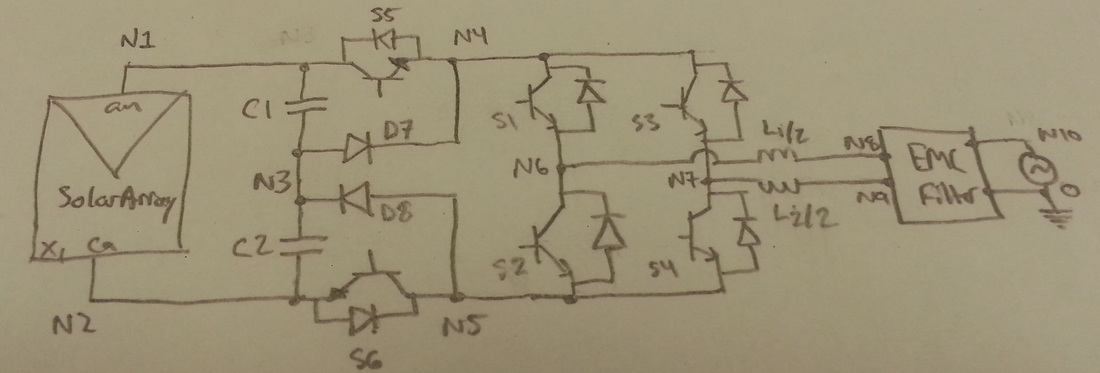
In the two SPICE plots below, all of the relevant node voltages and currents are shown for several continuous switching cycles. The node numbering scheme can be seen in the schematic below.
IGBT
|
SiC FET
|
Topology Nodes for Reference