| |
175. |
|
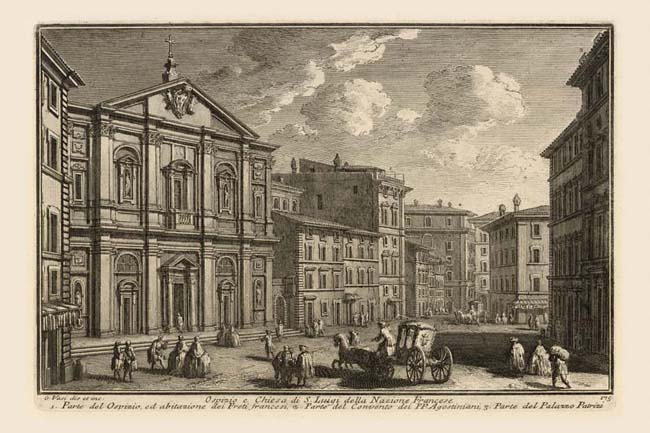
Ospizio e Chiesa di S. Luigi detta Nazione Francese |
|
 |
|
 |
|
 |
|
| |
|
Chiesa di S. Luigi della Nazione Francese |
| |
1. |
Parte del Ospizio ed abitazione dei Preti Francesi |
| |
2. |
Parte del Convento dei PP. Agostiniani |
| |
3. |
Parte del Palazzo Patrizi |
There were numerous national groups in Rome, each with its own church, some with an attached ospizio (hospice) to house pilgrims from the mother country. The French neighborhood in Rome clustered around the church dedicated to St. Louis King Louis IX of France 1214-1270). S. Luigi was built in the mid to late 16th century and is attributed to various architects including Della Porta and Domenico Fontana. Nolli shows that the arched gate immediately to the right of the church once led to a narrow street running right through the block to the nearby Piazza Madama, Plate 70, subsequently blocked at that end by a 19th century building. The tall, narrow building on the corner of the next block is the early 18th century hospice (1) which housed both French pilgrims and the priests who officiated at S. Luigi. The next block is part of the Collegio Germanico-Ungarico (NN 814), while the building at the end of the urban space is the corner of the block-sized Convento degli Agostiniani (2) Plate 107, attached to the church of S. Agostino. This building stands at the beginning of the Via della Scrofa/Via di Ripetta axis, one of the three streets converging on Piazza del Popolo. At the right edge of the print is the main portal of Palazzo Patrizi (3) built in the late 16th century, but reworked in the following three centuries.
|
