[Menu] [Previous] [Next]
TUTORIAL: Clinical PET - Neurology
Use the "Menu" button to jump to the Let's Play PET Main Menu or click on the Next and Previous buttons to proceed sequentially through the topics and tutorials. Or, you can return to the Department of Molecular and Medical Pharmacology's Home Page.Contents:
Topics:
Alzheimer's Disease
All of us, at one time or another, have forgotten things and have had occasional difficulty with memory. This is very different from Alzheimer's Disease (AD), a degenerative disorder that is the most common neurologic cause of dementia. Alzheimer's disease has a unique pathology, with a characteristic breakdown or deterioration of cells throughout the brain. Portions of the brain are damaged and collect clumps or deposits of degenerating cells and processes called neuritic plaques, and filamentous material called neurofibrillary tangles. Alzheimer's patients have difficulty with their usual daily activities, undergo behavioral changes, and sustain a loss of memory, particularly memory for recent events.
Introduction
Although people have called this disorder by different names, Alzheimer's disease (AD) has been around for centuries. Written descriptions date back to ancient greeks. It was not until 1906, however, that the German pathologist Louis Alzheimer first saw the characteristic plaques and nerve tangles in autopsy tissue from people who had suffered from dementia. Alzheimer correlated these brain abnormalities with the memory problems of his patients. About one out of every 20 people over the age of 65 suffers from some form of dementia. Alzheimer's disease, a particular type of dementia, accounts for about half of those cases. The older a person gets, the more likely he or she is to develop the disease. The risk for AD increases about 1 percent for each year over 65. After age 85, a person's chance of developing AD has increased from 1 in 20 to 1 in 2.
Source: NIH Publication No. 88-2982
Diagnosis of Alzheimer's Disease
Diagnosing Alzheimer's Disease in its later stages is not difficult. But how do doctors make the initial determination in the early stages of the illness? Currently, there is no method that is 100 percent accurate. The only way to definitively diagnose AD is to examine the brain under a microscope after death (perform an autopsy), and to look for the telltale plaques and neurofibrillary tangles.
We do not yet know the underlying mechanism that causes these brain cell abnormalities in Alzheimer's Disease. We do know that the damage caused by Alzheimer's is scattered throughout the brain, rather than concentrated in any particular region.
There are a few diagnostic tools that can be used in patients to help determine if they have the disease. Eventually, the ability to obtain an early diagnosis may save or prolong the lives of patients. One tool is the biopsy, the surgical removal of a small piece of brain tissue to diagnose the illness. Only a few physicians in the U.S. and abroad perform the procedure, simply because it is so invasive. Another, more familiar tool is the CT scan, a three dimensional X-ray of the brain. The CT scan image shows that the solid portion of the brain of Alzheimer's patients, the gray matter, has shrunk and the spaces in between, filled with ventricular fluid, have enlarged. However, not all people with AD have these kinds of changes, so the diagnosis by CT scan is not 100 percent reliable.
Another test under development involves sampling the cerebrospinal fluid through a procedure called a spinal tap or lumbar puncture. Because the brain and the spinal cord are connected, fluid that bathes the brain eventually is collected in a small sac at the base of the spine. Extracting and analyzing the fluid from this sac may help diagnose the disease. Recently, researchers found an abnormal protein that is present in the brains of Alzheimer's patients, which may be present in the cerebrospinal fluid. If so, the spinal tap may become an accurate and less invasive method for diagnosing AD.
Other types of diagnostic tests simply rule out the possibility of other diseases. A thyroid gland abnormality, an infection, anemia, or cancer that has spread to the brain can mimic some of the symptoms of AD. A stroke that damages the brain can also have some similarities with AD, but an X-ray image reveals that the damage is at specific sites and often associated with such physical symptoms as the dragging of a foot or partial facial paralysis. Severe alcoholism also is associated with memory disturbance and dementia, as is the type of repeated head injury encountered by a professional fighter. Parkinson's Disease often is mistaken for Alzheimer's. Perhaps most significantly, severe depression also has symptoms akin to AD.
The inclusion of depression is important, not because it is the most common illness that shows similarities to Alzheimer's, but because it is one of the only illnesses on the above list that can be treated and reversed. Depression and Alzheimer's may at first appear quite different; we associate the former with a person feeling extremely sad and hopeless, while the latter might be exemplified by a demented patient who can't remember what day it is. In fact, people over the age of 65 who are depressed often complain of loss of memory. So to differentiate between depression, a curable disease, and Alzheimer's, a currently incurable illness, is both critical and difficult.
Source: NIH Publication No. 88-2982
Use of PET in the Study of Alzheimer's Disease
It now appears possible to diagnose Alzheimer's disease early in its course, noninvasively and reliably with PET. It has been over ten years since the first report from PET laboratories described decrements in cerebral blood flow, oxygen utilization and glucose metabolism in the parietal and temporal lobes of patients with Alzheimer's disease. Since that time, these findings have been extensively confirmed by numerous independent laboratories. The lack of any other clinical, biochemical or genetic marker for Alzheimer's disease during life makes these findings unique and of clinical relevance. We will now examine a series of PET scans taken from an Alzheimer's patient over a number of years.
Click on image above to view full-size image.
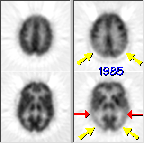
For reference, the image on the left is an FDG-PET scan from a normal volunteer. The AD patient was first scanned in 1985, as shown above on the right. Note the decreased metabolic activity evident in the parietal (yellow arrows) and temporal (red arrows) lobes. Hypometabolism of the temporal and parietal cortices is common in mildly demented patients, and this profile appears to be indicative of the early stages of Alzheimer's disease. A large number of patients with signs and symptoms of dementia that have hypometabolism of the parietal and temporal lobes have had the diagnosis of Alzheimer's disease confirmed by biopsy or autopsy.
Click on image above to view full-size image.
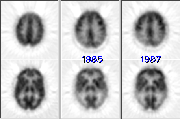
An FDG-PET scan of the same patient in 1987 re-confirms the metabolic deterioriation.
Click on image above to view full-size image.
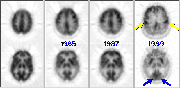
In the patient's 1989 FDG-PET scan, additional metabolic deterioration is apparent (Note: the 1989 images were acquired with a higher resolution scanner). The affected areas in the later stages of Alzheimer's disease typically include most regions of the cerebral cortex; particularly the parietal, temporal and frontal cortices (the frontal cortex typically becomes affected in later stages of the disease). There is relative sparing of primary sensorimotor cortex (yellow arrows), and of the primary visual cortex (blue arrows). In addition, phylogenetically more primitive subcortical structures of the brain are fairly well-preserved. This metabolic pattern is a distinguishing feature of Alzheimer's disease in neurological FDG-PET studies. Note that while structural imaging techniques such as MRI and CT are excellent in identifying the causes of dementia that have a structurally identifiable basis, PET imaging through metabolism has the ability to distinguish Alzheimer's disease from pseudodementia, Pick's disease, or early Huntington's as well as to identify individuals who have incidental cerebral infarctions superimposed on degenerative dementing processes.
Click on image above to view full-size image.
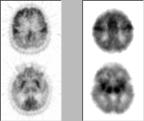
Finally, compare the late-stage AD scan with the scan of a normal newborn. As can be seen in these images, an adult in the later stages of AD has an FDG-PET scan similar to that of a newborn (and behavior in these two groups of individuals is similar, too). Note, however, that the visual cortex is relatively unaffected in AD, whereas the visual cortex in a newborn is metabolically undeveloped.
The scans in this next section are from a longitudinal study of patients with probable Alzheimer's disease. These patients exhibit a constant metabolc deficit, particularly in the parietal and temporal lobes.
Case 1
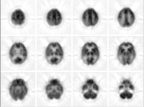
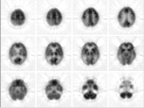
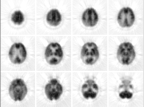
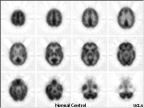
Click on one or more of the images above to view full-size image(s).
- Female patient (born 1929); scans from left to right, top row: 1985, 1986, and 1987
- Female normal control (born 1917); scan on bottom row
Case 2
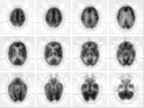
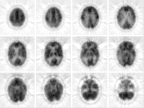
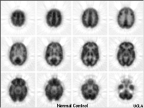
Click on one or more of the images above to view full-size image(s).
- Male patient (born 1931); scans from left to right, top row: 1985 and 1986
- Male normal control (born 1916); scan on bottom row
Note that cortical metabolism is significantly more homogeneous in the control patient.
Case 3
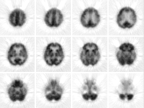
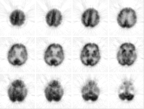
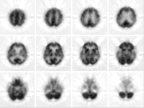
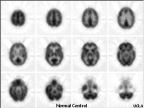
Click on one or more of the images above to view full-size image(s).
- Female patient (born 1915); scans from left to right, top row: 1985, 1986, and 1987
- Female normal control (born 1917); scan on bottom row
Case 4
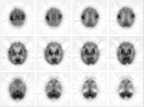
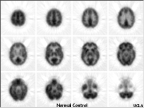
Click on one or more of the images above to view full-size image(s).
- Female patient (born 1910); scan on left from 1984
- Female normal control (born 1917); scan on right
[Menu] [Previous] [Next]