[Menu] [Previous] [Next]
TUTORIAL: Clinical PET - Neurology
Use the "Menu" button to jump to the Let's Play PET Main Menu or click on the Next and Previous buttons to proceed sequentially through the topics and tutorials. Or, you can return to the Department of Molecular and Medical Pharmacology's Home Page.Contents:
Topics:
Metabolic Development of the Brain
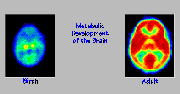
Click on image above to view full-size image.
The organization of the brain undergoes dramatic changes between birth and adulthood. These changes in structure are also reflected in the pattern of glucose utilization. CMRGlc studies with PET have been used to map out the temporal course of metabolic maturation of the human. In this tutorial we will explore cerebral glucose metabolism from birth to adulthood.
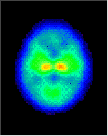
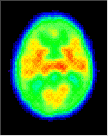
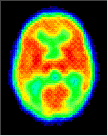
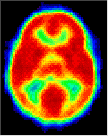
Click on one more more of the images above to view full-size image(s).
The images above are a simulation of relative glucose utilization. In infants 5 weeks of age and younger, glucose utilization is highest in the sensorimotor cortex, thalamus, brainstem and cerebellum. The rate of glucose utilization is relatively very low in the basal ganglia and cerebral cortex at this age. By about 3 months of age an increase in glucose utilization is seen throughout much of the cerebral cortex, and the rate in the basal ganglia approaches that of the thalamus. In addition, the sensorimotor cortex, already active at birth, continues to show increases in activity. The frontal cortex and several association cortical regions, however, remain less metabolically active than the rest of the brain. A pattern of glucose utilization resembling the adult is seen as early as 8 months and typically by 1 year of age. Taken together the data on patterns of cerebral glucose utilization support the thesis that there is a relationship between a metabolic increase within neuroanatomical structures and the emergence of corresponding function. For example, neonatal behavior is primarily dominated by subcortical brain structure activity. Intrinsic brainstem reflexes, such as the Moro, root and grasp reflexes, are prominent. Visuomotor function is present only in rudimentary form, and cortical function is mostly limited to primary sensory and motor areas. By 3 to 4 months, purposeless limb movements begin to be replaced by more coordinated motions as the infant reaches out for objects. The increasing metabolic rate seen in the cerebellar hemispheres and parietal cortex may be important in this context. By 8 to 9 months, the cognitive development is thought to begin in the human infant and the PET images now show increased glucose metabolism in frontal and association cortices, areas intimately involved with higher cortical function.
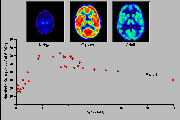
Click on image above to view full-size image.
The graph above represents average absolute glucose utilization (µmole/min/100g tissue) in the cerebral hemispheres of subjects of different ages. Note that although the pattern of glucose utilization at 1 year of age is similar to that of the adult, absolute values of glucose metabolism are lower in infants than in adults. Adult rates are evident by 2 years of age but the glucose metabolic rate continues to increase until approximately 9 years of age, when they begin to decline, reaching adult values in the latter part of the second decade of life. Phylogenetically old structures, such as the brainstem, that were mature at birth did not show this increase to excessive CMRGlc.
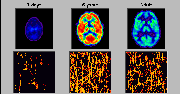
Click on image above to view full-size image.
The high CMRGlc during 3 to 10 years corresponds to the period of exuberant connectivity in humans and is probably required to meet the energy demands of the neuronal processes and synapses that are also in excess by about a factor of two compared to adults. Shown above are PET scans from 3 different ages showing the relative glucose metabolic rate. Beneath the PET scans are drawings showing the relative complexity of the dendritic structure of cortical neurons. The progressive increase in glucose utilization seen in development is consistent with anatomical studies showing an expansion of dendritic fields (and synaptic connectivity) and an increase in capillary density in the human frontal cortex during the same period. Thus, it is possible that the decrease in glucose metabolic rate in the adult reflects a "pruning" of excessive neuronal connectivity and a selective stabilization of the remaining neuronal connections.
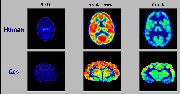
Click on image above to view full-size image.
Finally, compare the local cerebral metabolic rate of humans during development with a quantitative [14C]2-deoxyglucose autoradiography study of the cat. Just as in the human PET study, the data from the cat reveal a parallel between local glucose metabolic rates and behavioral development. Taken together these studies support the hypothesis that the onset of diminishing plasticity for a specific brain region or system can be identified by the age when its resting glucose metabolic rate begins to show a developmental decline from previously excessive levels.
Credits
Material for this section was kindly provided by:Michael E. Phelps, Ph.D.
Dept. of Molecular and Medical Pharmacology
UCLA School of Medicine
John Mazziotta, M.D., Ph.D.
Dept. of Molecular and Medical Pharmacology and
Dept. of Neurology
UCLA School of Medicine
Harry T. Chugani, M.D.
Pediatric PET Center
Children's Hospital
Wayne State University
[Menu] [Previous] [Next]