[Menu] [Previous] [Next]
TUTORIAL: Clinical PET - Cardiology
Use the "Menu" button to jump to the Let's Play PET Main Menu or click on the Next (right arrowhead) and Previous (left arrowhead) buttons to proceed sequentially through the topics and tutorials. Or, you can return to the Department of Molecular and Medical Pharmacology's Home Page.Contents:
Topics:
Ischemic Dilated Cardiomyopathy
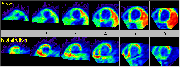
Click on image above to view full-size image.
Ischemic dilated cardiomyopathy is a condition in which there is poor perfusion of the myocardial wall resulting in poor contractile function. The myocardial compensation results in a large dilated myocardium with an enlarged LV. Shown above are flow and FDG metabolic studies from an ischemic dilated cardiomyopathy patient. Note the enlarged heart size with the large LV. It is also evident that there is decreased perfusion to the anterior, septal, and other portions of the heart. There is also increased glucose metabolism in these same regions. This is an important finding, because it must be differentiated from idiopathic dilated cardiomyopathy, where there is no ischemia and no hope for direct re-vascularization.
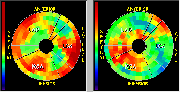
Click on image above to view full-size image.
Shown here are the polar maps obtained from the previous studies. The flow polar map shows decreased perfusion to the septal and antero-lateral regions. The FDG polar map shows enhanced metabolism in these same regions. Note that anatomical information about a dilated heart is not directly apparent in a polar map.
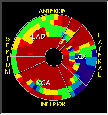
Click on image above to view full-size image.
This polar map above was obtained by subtracting the metabolism polar map from the flow polar map. The areas in red represent the greatest mismatch. It is apparent that large areas of myocardium show a mismatch between flow and metabolism. This is consistent with an ischemic dilated cardiomyopathy condition, in which there are regions of low perfusion and hypermetabolism. Intervention with angioplasty or bypass surgery can be useful in these patients because flow can be restored and myocardial function improved. This is in contrast to (non-ischemic) dilated cardiomyopathy, where no intervention other than a transplant would be of significance.
Credits
Material for this section was kindly provided by:Johannes Czernin, M.D.
Dept. of Molecular and Medical Pharmacology
UCLA School of Medicine
Heinrich R. Schelbert, M.D., Ph.D.
Dept. of Molecular and Medical Pharmacology
UCLA School of Medicine
[Menu] [Previous] [Next]