[Menu] [Previous] [Next]
TUTORIAL: Clinical PET - Cardiology
Use the "Menu" button to jump to the Let's Play PET Main Menu or click on the Next and Previous buttons to proceed sequentially through the topics and tutorials. Or, you can return to the Department of Molecular and Medical Pharmacology's Home Page.Contents:
Topics:
Cardiac Scan Evaluation
Cardiac Anatomy
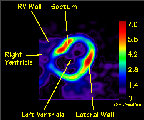
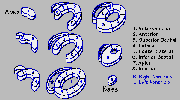
Click on one or more of the images above to view full-size image(s).
Cardiac PET images are normally obtained as a set of transverse cross-sectional images. In general, the heart and tomograph long axes deviate so that oblique images are obtained. Shown above is an example of a typical PET image obtained approximately one hour after the injection of FDG, with some anatomic labeling.
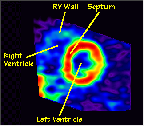
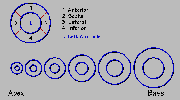
Click on one or more of the images above to view full-size image(s).
Shown above is an example of an image obtained from re-slicing the original PET data set. This is useful in obtaining short-axis views, so that all portions of the myocardium can be visualized properly.
Image Interpretation
Various forms of cardiac pathology can be characterized with PET. In the following section we will provide a framework for how to analyze a cardiac PET scan to determine if pathology is present. Let us begin by simplifying all cardiac PET images so that they are comprised of only three colors: red for high pixel values, green for normal values, and blue for low values. This simplified color scale is shown above. Furthermore, let us assume that all images are normalized to this scale, so that images from different studies are comparable. Often PET images are not normalized to each other. A direct qualitative comparison is only possible when images from different studies have been normalized to the same scale.
Click on image above to view full-size image.
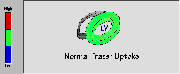
A tracer study of a normal myocardium is schematically illustrated above. The left ventricle (LV) is shown, and the tissue (myocardial wall) is represented as a ring. The homogeneous green color indicates that there is normal tracer uptake over all regions of the myocardium. Thus, this might represent a normal flow or normal metabolism study.
Click on image above to view full-size image.
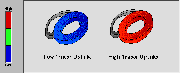
Depicted above are scans from two studies. The study on the left reveals low tracer uptake (blue color), and the study on the right reveals high tracer uptake (red color). Such images could be obtained from either a flow (e.g., NH3) or metabolic (FDG) study of the myocardium.
Click on image above to view full-size image.
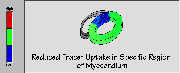
The above represents a tracer study in which there is normal tracer uptake in all but the superior septal portions of the myocardium, where there is low tracer uptake. If this were a flow study, it would represent decreased perfusion in the superior septal region. The next several segments will show various pathological patterns encountered in PET cardiac images (using the simplified three color scale).
Click on image above to view full-size image.
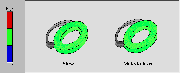
The image on the left represents a normal flow study, and the image on the right represents a normal metabolic study. Together these two images support a diagnosis of a normally functioning myocardium, with no perfusion defects or metabolic abnormalities.
Click on image above to view full-size image.
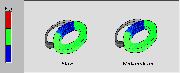
The flow image on the left is consistent with a perfusion defect (low flow) in the superior septal segment. The FDG metabolic study on the right reveals a low metabolic state, also in the superior septal segment. The flow pattern and the metabolic pattern are identical, and this condition is thus referred to as a "matched" study. The decreased metabolic state in the superior septal region suggests that little viable tissue is present in this region of the myocardium. FDG-PET is useful for cases like this one in that non-viable tissue which would not benefit from re-establishment of blood flow can be identified.
Click on image above to view full-size image.
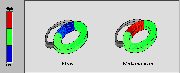
The flow image on the left is consistent with a perfusion defect (low flow) in the superior septal segment. The FDG metabolic study on the right reveals a high metabolic state in the same superior septal segment. The flow pattern and the metabolic pattern are inversely related, and this condition is thus referred to as a "mismatch" study. The high metabolic state is consistent with viable tissue, as this tissue is primarily dependent on glycolysis. PET can thus be useful in identifying viable tissue which might benefit from re-establishment of flow.
Click on image above to view full-size image.
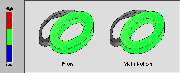
In the studies shown above, both flow and FDG metabolism are normal. However, the left ventricle is enlarged relative to a normal patient. This pattern represents a condition known as idiopathic dilated cardiomyopathy. The term idiopathic is applied because there is no apparent reason why the LV is dilated. No medical mangagement other than a transplant would be helpful in the case of idiopathic dilated cardiomyopathy. If the dilatation were due to ischemia (ischemic dilated cardiomyopathy), then one would expect the flow pattern to be low in some portions of the myocardium.
Click on image above to view full-size image.
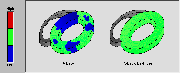
The flow study above shows several patchy perfusion defects (decreased tracer uptake). The FDG metabolic study is normal. Note that the LV is enlarged. This pattern is indicative of ischemic dilated cardiomyopathy, since there is a low flow state (ischemia) and dilatation of the myocardium. Revascularization is a possible management approach in this case. Note that a metabolism study might show a low metabolic state, in which case revascularization would be of little benefit. PET is useful for distinguishing idiopathic from ischemic dilated cardiomyopathy.
Click on image above to view full-size image.
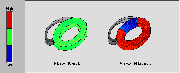
The image on the left represents a flow study performed with no exertion by the patient (a resting study). Note that tracer uptake is normal normal. The image on the right represents a flow study performed after the patient is asked to run on a treadmill (a stress study). Note that in the stress condition a perfusion defect is evident in the superior septal region, whereas the rest of the myocardium shows increased flow. This pattern is consistent with a stress-induced defect. One would see this type of stress-vs.-rest flow study in a case where a coronary blood vessel had a sufficently small stenosis such that under resting condition there was normal flow to the supplied region and under increased myocardial demand the flow to that same region was inadequate.
Click on image above to view full-size image.
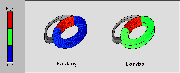
The primary substrates for the myocardium are fatty acids and not glucose. Therefore the dietary state of the individual can affect the FDG metabolic images obtained. Shown above are the fasting and glucose loaded FDG metabolic studies in a study where the superior septal region is still viable. Under fasting conditions, normal myocardium utilizes glucose, and ischemic myocardium also utilizes glucose, but at a higher rate than normal myocardium (if it is viable). After loading the patient with glucose, the ischemic portion still utilizes glucose at a higher rate than normal myocardium, but now the normal portions of myocardium have normal, as opposed to low, utilization rates. Most FDG PET studies are performed under loaded conditions.
Click on image above to view full-size image.
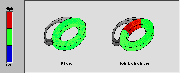
Shown above is an example of flow and FDG metabolism studies typical of hibernating myocardium. In this case the flow is normal to all regions, but the metabolism in the antero-septal segment is high. This antero-septal region is being perfused properly, but metabolism is increased indicating hibernating myocardium. This may be seen if the region of myocardium has previously had abnormal perfusion.
Credits
Material for this section was kindly provided by:Johannes Czernin, M.D.
Dept. of Molecular and Medical Pharmacology
UCLA School of Medicine
Sanjiv Gambhir, M.D., Ph.D.
Crump Institute for Molecular Imaging
Dept. of Molecular and Medical Pharmacology
UCLA School of Medicine
Richard Brunken, M.D.
Heinrich R. Schelbert, M.D., Ph.D.
Dept. of Molecular and Medical Pharmacology
UCLA School of Medicine
[Menu] [Previous] [Next]