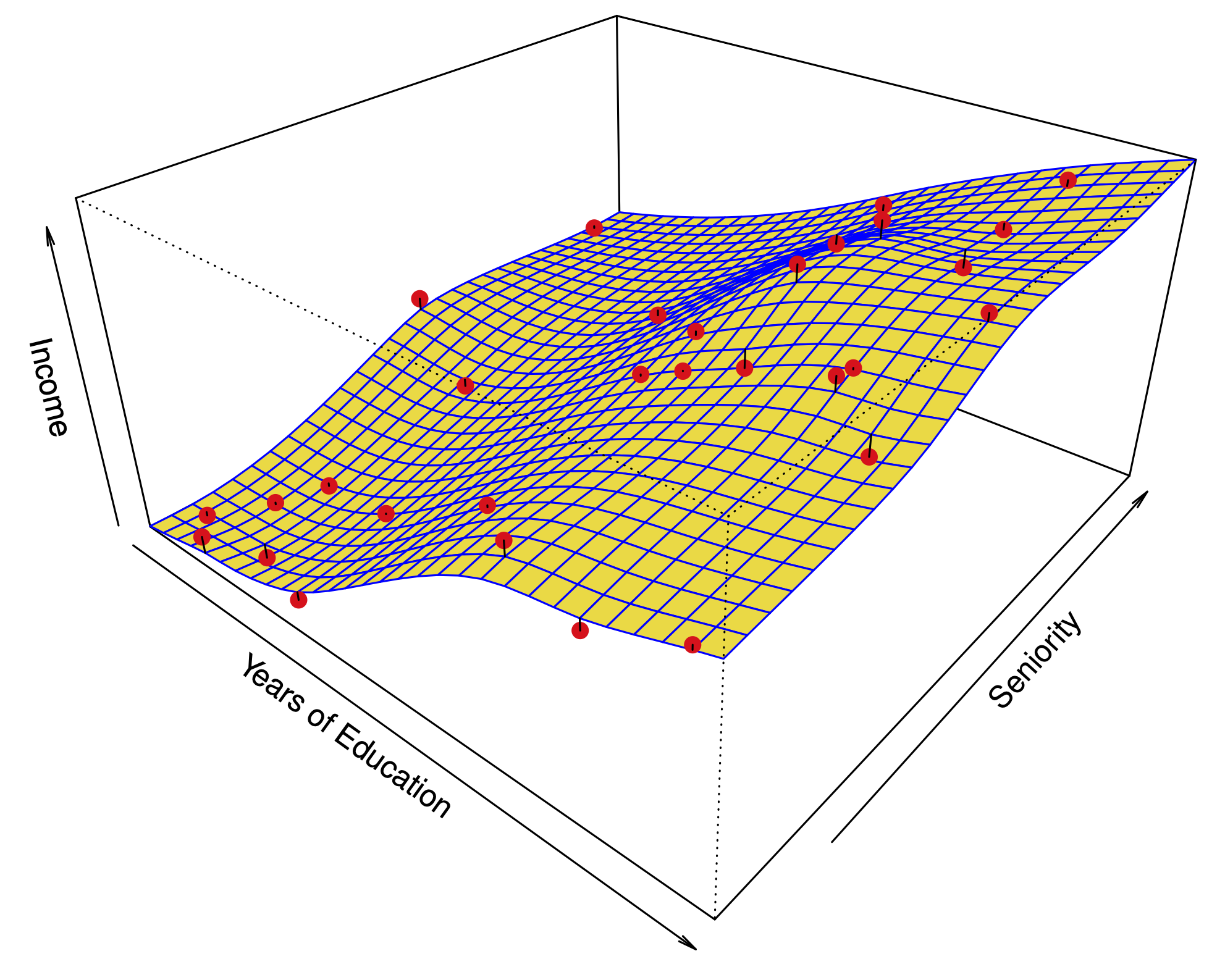
Topics covered in course
Models for discrete data
Draw \(X_i \overset{IID}{\sim} F , 1 \leq i \leq N\)
Let \(R(X_i), C(X_i)\) be discrete random variables: presence or absence of a trait; labelling a trait.
Sample can be summarized in table
\(c_1\) |
\(\dots\) |
\(c_J\) |
Row total |
|
|---|---|---|---|---|
\(r_1\) |
\(Y_{11}\) |
\(\dots\) |
\(Y_{1J}\) |
\(Y_{1.}\) |
\(\vdots\) |
\(\dots\) |
\(\dots\) |
\(\dots\) |
\(\dots\) |
\(r_I\) |
\(Y_{I1}\) |
\(\dots\) |
\(Y_{IJ}\) |
\(Y_{I.}\) |
Column total |
\(Y_{.1}\) |
\(\dots\) |
\(Y_{.J}\) |
\(Y_{..}\) |
Distribution described by
Common questions
Independence
Homogeneity: when \(I=J\) and values are common
Regression

Linear regression
Response matrix: \(Y \in \mathbb{R}^{n \times q}\)
Design matrix: \(X \in \mathbb{R}^{n \times p}\)
Usual estimation problem
Binary regression models: \(Y \in \{0,1\}^n\)
Usual model
For some CDF \(F\):
Common choices:
probit: \(F \sim N(0,1)\)logit: \(F(x) = e^x/(1+e^x)\).
Usual estimation problem
Asymptotic distribution? Inference?
Survival analysis
\(T\) a survival time
Basic object: survival function and hazard
Complications: censoring, truncation.
Non-parameteric methods
Kaplan-Meier estimator: direct estimate of \(P(T > t)\) based on IID draws of censored observations from \(F\)
Log-rank test
Usual model
Cox model: