Bayesian methods for GLMs (7.2)
Given design matrix \(X\) and binary \(Y\), we want a Bayesian model for the law of \(Y|X\).
Model
Log of posterior density is proportional to (suppressing \(X\) as is commonly done)
Generally is not going to be recognizable as a familiar distribution.
Metropolis-Hastings
Requires a proposal kernel \(K : \mathbb{R}^p \times \mathbb{R}^p \rightarrow \mathbb{R}\) so that \(K(\cdot | \beta)\) is a pdf for each \(\beta\).
Simple proposal: \(\beta' \overset{D}{=} \beta + N(0, \Sigma)\) (or other symmetric density) is
Accept proposal with probability
With a symmetric proposal, the ratio is just
Gibbs sampling
Instead of proposing a new \(\mathbb{R}^p\) vector, moves a coordinate at a time.
Define
Each \((\beta_{-j},Y)\) (again \(X\) suppressed) determines a conditional density for \(\beta_j\).
Sometimes (but not always) this density will be “simpler” than \(g(\beta|Y)\). Even possible that this family is from a known distribution, particularly using conjugate priors.
Gibbs sampler
gibbs_sampler = function() {
    beta = rep(0, num_features)
    for (i in 1:enough_iterations) {
        for (f in 1:num_features) {
            cur_post = objective(X, Y, prior, "binomial", beta, j)
            beta[j] = sample_univariate(exp(cur_post))
        }
    }
}
Threshold model
Recall the latent threshold model for binary data. With (inverse) link \(F\), we model
with \(T_i \sim F\).
In this case, posterior distribution can be realized using \(T_i\)’s instead of \(Y\)
MCMC samplers draw samples \((T,\beta) | T \leq X \beta\) with \(T_i|\beta, Y_i \overset{IID}{\sim} F, \beta \sim g\).
Known as data augmentation…
Threshold probit model (7.2.6)
When \(F=\Phi\), i.e. with probit link and \(\beta \sim N(\mu, \Sigma)\), then \((T,\beta)\) are jointly Gaussian.
Posterior sampling reduces to sampling multivariate truncated Normal. A common sampling problem for which Gibbs sampling is quite tractable.
Gibbs-ish sampler for multivariate truncated Normal
Suppose we want to sample from \(Z \sim N(\mu,\Sigma) | AZ \leq b\) for fixed \((A,b)\).
For simplicity, assume \(\Sigma=I\).
What is the Gibbs move for coordinate \(j\)?
The inequalities \(AZ \leq b\), conditional on \(Z_{-j}\), reduce to $\( L(Z_{-j}, A, b) \leq Z_j \leq U(Z_{-j}, A, b) \)$
Draw \(Z_j\) from \(N(\mu_j, 1)\) truncated to interval \([L, U]\).
Example of hit and run sampling.
STAN
While these are general purpose sampling schemes (with a huge literature of their own), practically speaking people use software for (at least simple) Bayesian analyses.
Sampling is not Gibbs or MH, but a variant of Hamiltonian MCMC.
Let’s do a simple example in Agresti’s favorite
crabsdata.
library(glmbb) # for `crabs` data
data(crabs)
M_crabs = glm(y ~ width + color, family=binomial, data=crabs)
X_crabs = model.matrix(M_crabs)
crabs_stan = list(X = X_crabs,
                  N = nrow(X_crabs),
                  P = ncol(X_crabs),
                  y = crabs$y)
Stan file logit_uninformative.stan
data {
  int<lower=1> N;
  int<lower=1> P;
  matrix[N,P] X;
  int<lower=0,upper=1> y[N];
}
parameters {
  vector[P] beta;
}
model {
  beta ~ normal(0, 100);
  y ~ bernoulli_logit(X * beta);
}
library(rstan)
system.time(samples <- rstan::stan("logit_uninformative.stan",
                                   data=crabs_stan))
Loading required package: StanHeaders
Loading required package: ggplot2
rstan (Version 2.21.3, GitRev: 2e1f913d3ca3)
For execution on a local, multicore CPU with excess RAM we recommend calling
options(mc.cores = parallel::detectCores()).
To avoid recompilation of unchanged Stan programs, we recommend calling
rstan_options(auto_write = TRUE)
SAMPLING FOR MODEL 'logit_uninformative' NOW (CHAIN 1).
Chain 1:
Chain 1: Gradient evaluation took 3.9e-05 seconds
Chain 1: 1000 transitions using 10 leapfrog steps per transition would take 0.39 seconds.
Chain 1: Adjust your expectations accordingly!
Chain 1:
Chain 1:
Chain 1: Iteration:    1 / 2000 [  0%]  (Warmup)
Chain 1: Iteration:  200 / 2000 [ 10%]  (Warmup)
Chain 1: Iteration:  400 / 2000 [ 20%]  (Warmup)
Chain 1: Iteration:  600 / 2000 [ 30%]  (Warmup)
Chain 1: Iteration:  800 / 2000 [ 40%]  (Warmup)
Chain 1: Iteration: 1000 / 2000 [ 50%]  (Warmup)
Chain 1: Iteration: 1001 / 2000 [ 50%]  (Sampling)
Chain 1: Iteration: 1200 / 2000 [ 60%]  (Sampling)
Chain 1: Iteration: 1400 / 2000 [ 70%]  (Sampling)
Chain 1: Iteration: 1600 / 2000 [ 80%]  (Sampling)
Chain 1: Iteration: 1800 / 2000 [ 90%]  (Sampling)
Chain 1: Iteration: 2000 / 2000 [100%]  (Sampling)
Chain 1:
Chain 1:  Elapsed Time: 1.36337 seconds (Warm-up)
Chain 1:                1.0939 seconds (Sampling)
Chain 1:                2.45726 seconds (Total)
Chain 1:

SAMPLING FOR MODEL 'logit_uninformative' NOW (CHAIN 2).
Chain 2:
Chain 2: Gradient evaluation took 1.6e-05 seconds
Chain 2: 1000 transitions using 10 leapfrog steps per transition would take 0.16 seconds.
Chain 2: Adjust your expectations accordingly!
Chain 2:
Chain 2:
Chain 2: Iteration:    1 / 2000 [  0%]  (Warmup)
Chain 2: Iteration:  200 / 2000 [ 10%]  (Warmup)
Chain 2: Iteration:  400 / 2000 [ 20%]  (Warmup)
Chain 2: Iteration:  600 / 2000 [ 30%]  (Warmup)
Chain 2: Iteration:  800 / 2000 [ 40%]  (Warmup)
Chain 2: Iteration: 1000 / 2000 [ 50%]  (Warmup)
Chain 2: Iteration: 1001 / 2000 [ 50%]  (Sampling)
Chain 2: Iteration: 1200 / 2000 [ 60%]  (Sampling)
Chain 2: Iteration: 1400 / 2000 [ 70%]  (Sampling)
Chain 2: Iteration: 1600 / 2000 [ 80%]  (Sampling)
Chain 2: Iteration: 1800 / 2000 [ 90%]  (Sampling)
Chain 2: Iteration: 2000 / 2000 [100%]  (Sampling)
Chain 2:
Chain 2:  Elapsed Time: 1.38845 seconds (Warm-up)
Chain 2:                1.00608 seconds (Sampling)
Chain 2:                2.39453 seconds (Total)
Chain 2:

SAMPLING FOR MODEL 'logit_uninformative' NOW (CHAIN 3).
Chain 3:
Chain 3: Gradient evaluation took 1.2e-05 seconds
Chain 3: 1000 transitions using 10 leapfrog steps per transition would take 0.12 seconds.
Chain 3: Adjust your expectations accordingly!
Chain 3:
Chain 3:
Chain 3: Iteration:    1 / 2000 [  0%]  (Warmup)
Chain 3: Iteration:  200 / 2000 [ 10%]  (Warmup)
Chain 3: Iteration:  400 / 2000 [ 20%]  (Warmup)
Chain 3: Iteration:  600 / 2000 [ 30%]  (Warmup)
Chain 3: Iteration:  800 / 2000 [ 40%]  (Warmup)
Chain 3: Iteration: 1000 / 2000 [ 50%]  (Warmup)
Chain 3: Iteration: 1001 / 2000 [ 50%]  (Sampling)
Chain 3: Iteration: 1200 / 2000 [ 60%]  (Sampling)
Chain 3: Iteration: 1400 / 2000 [ 70%]  (Sampling)
Chain 3: Iteration: 1600 / 2000 [ 80%]  (Sampling)
Chain 3: Iteration: 1800 / 2000 [ 90%]  (Sampling)
Chain 3: Iteration: 2000 / 2000 [100%]  (Sampling)
Chain 3:
Chain 3:  Elapsed Time: 1.45103 seconds (Warm-up)
Chain 3:                0.976768 seconds (Sampling)
Chain 3:                2.4278 seconds (Total)
Chain 3:

SAMPLING FOR MODEL 'logit_uninformative' NOW (CHAIN 4).
Chain 4:
Chain 4: Gradient evaluation took 1.7e-05 seconds
Chain 4: 1000 transitions using 10 leapfrog steps per transition would take 0.17 seconds.
Chain 4: Adjust your expectations accordingly!
Chain 4:
Chain 4:
Chain 4: Iteration:    1 / 2000 [  0%]  (Warmup)
Chain 4: Iteration:  200 / 2000 [ 10%]  (Warmup)
Chain 4: Iteration:  400 / 2000 [ 20%]  (Warmup)
Chain 4: Iteration:  600 / 2000 [ 30%]  (Warmup)
Chain 4: Iteration:  800 / 2000 [ 40%]  (Warmup)
Chain 4: Iteration: 1000 / 2000 [ 50%]  (Warmup)
Chain 4: Iteration: 1001 / 2000 [ 50%]  (Sampling)
Chain 4: Iteration: 1200 / 2000 [ 60%]  (Sampling)
Chain 4: Iteration: 1400 / 2000 [ 70%]  (Sampling)
Chain 4: Iteration: 1600 / 2000 [ 80%]  (Sampling)
Chain 4: Iteration: 1800 / 2000 [ 90%]  (Sampling)
Chain 4: Iteration: 2000 / 2000 [100%]  (Sampling)
Chain 4:
Chain 4:  Elapsed Time: 1.23988 seconds (Warm-up)
Chain 4:                1.21342 seconds (Sampling)
Chain 4:                2.45331 seconds (Total)
Chain 4:
   user  system elapsed
 32.544   1.855  39.365
samples
Inference for Stan model: logit_uninformative.
4 chains, each with iter=2000; warmup=1000; thin=1;
post-warmup draws per chain=1000, total post-warmup draws=4000.

          mean se_mean   sd    2.5%    25%    50%    75%  97.5% n_eff Rhat
beta[1] -12.03    0.08 2.82  -17.80 -13.86 -11.96 -10.09  -6.79  1410    1
beta[2]   0.48    0.00 0.11    0.28   0.41   0.48   0.56   0.71  1383    1
beta[3]  -1.18    0.01 0.61   -2.36  -1.58  -1.18  -0.77   0.01  2163    1
beta[4]   0.30    0.02 0.84   -1.21  -0.26   0.26   0.81   2.12  2125    1
beta[5]   0.30    0.01 0.44   -0.55   0.01   0.31   0.58   1.16  1976    1
lp__    -96.36    0.04 1.67 -100.61 -97.27 -96.01 -95.11 -94.16  1419    1

Samples were drawn using NUTS(diag_e) at Wed Feb  2 10:49:18 2022.
For each parameter, n_eff is a crude measure of effective sample size,
and Rhat is the potential scale reduction factor on split chains (at
convergence, Rhat=1).
samples
Inference for Stan model: logit_uninformative.
4 chains, each with iter=2000; warmup=1000; thin=1;
post-warmup draws per chain=1000, total post-warmup draws=4000.

          mean se_mean   sd    2.5%    25%    50%    75%  97.5% n_eff Rhat
beta[1] -12.03    0.08 2.82  -17.80 -13.86 -11.96 -10.09  -6.79  1410    1
beta[2]   0.48    0.00 0.11    0.28   0.41   0.48   0.56   0.71  1383    1
beta[3]  -1.18    0.01 0.61   -2.36  -1.58  -1.18  -0.77   0.01  2163    1
beta[4]   0.30    0.02 0.84   -1.21  -0.26   0.26   0.81   2.12  2125    1
beta[5]   0.30    0.01 0.44   -0.55   0.01   0.31   0.58   1.16  1976    1
lp__    -96.36    0.04 1.67 -100.61 -97.27 -96.01 -95.11 -94.16  1419    1

Samples were drawn using NUTS(diag_e) at Wed Feb  2 10:49:18 2022.
For each parameter, n_eff is a crude measure of effective sample size,
and Rhat is the potential scale reduction factor on split chains (at
convergence, Rhat=1).
summary(M_crabs)
confint(M_crabs)
Call:
glm(formula = y ~ width + color, family = binomial, data = crabs)

Deviance Residuals:
    Min       1Q   Median       3Q      Max
-2.1124  -0.9848   0.5243   0.8513   2.1413

Coefficients:
            Estimate Std. Error z value Pr(>|z|)
(Intercept) -11.6090     2.7070  -4.289 1.80e-05 ***
width         0.4680     0.1055   4.434 9.26e-06 ***
colordarker  -1.1061     0.5921  -1.868   0.0617 .
colorlight    0.2238     0.7771   0.288   0.7733
colormedium   0.2962     0.4176   0.709   0.4781
---
Signif. codes:  0 ‘***’ 0.001 ‘**’ 0.01 ‘*’ 0.05 ‘.’ 0.1 ‘ ’ 1

(Dispersion parameter for binomial family taken to be 1)

    Null deviance: 225.76  on 172  degrees of freedom
Residual deviance: 187.46  on 168  degrees of freedom
AIC: 197.46

Number of Fisher Scoring iterations: 4
Waiting for profiling to be done...
| 2.5 % | 97.5 % | |
|---|---|---|
| (Intercept) | -17.2164739 | -6.55237372 |
| width | 0.2712817 | 0.68704361 |
| colordarker | -2.3138635 | 0.02792233 |
| colorlight | -1.2396603 | 1.89189591 |
| colormedium | -0.5325502 | 1.11213712 |
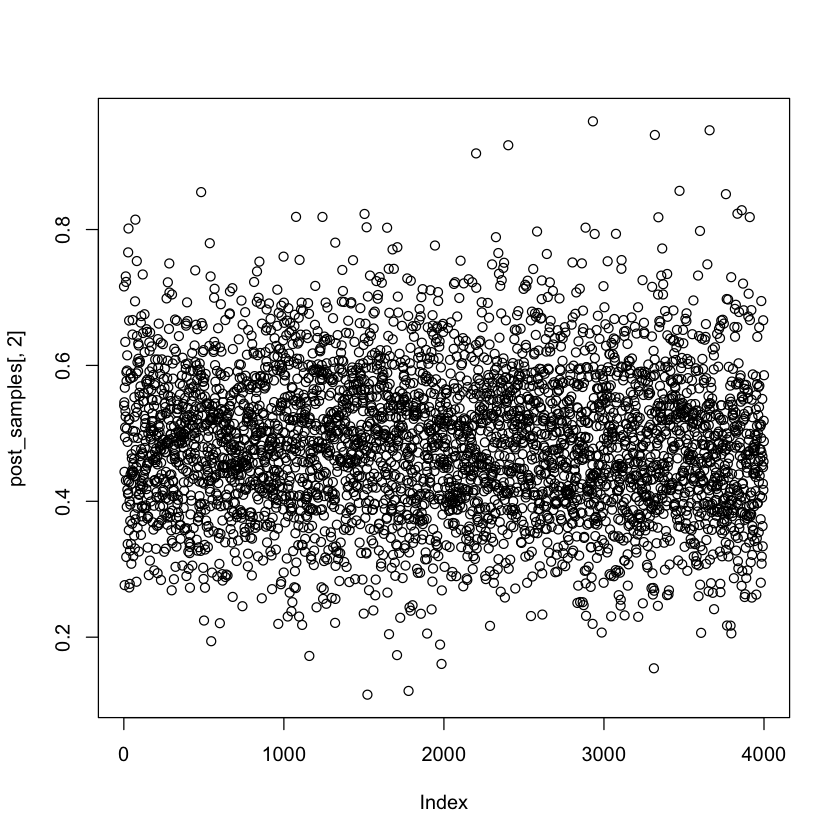
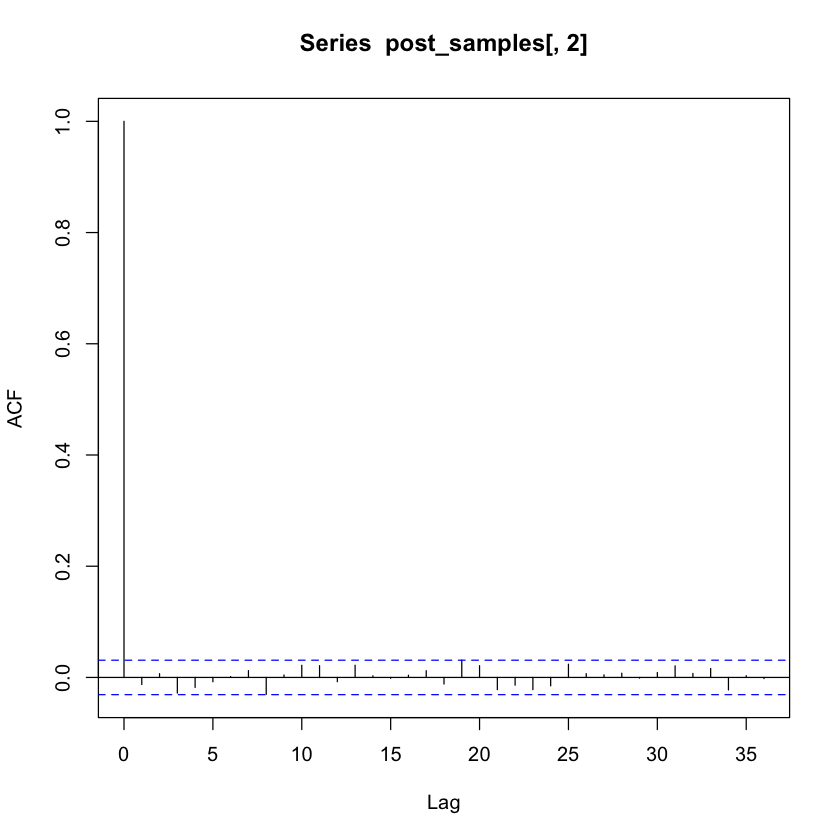
post_samples = extract(samples, "beta")$beta
plot(post_samples[,2])
Informative prior
Instead of prior \(\beta \sim N(0, 100 \cdot I)\) use \(N(0,I)\)
samples_i = rstan::stan("logit_informative.stan",
                         data=crabs_stan)
post_samples_i = extract(samples_i, "beta")$beta
SAMPLING FOR MODEL 'logit_informative' NOW (CHAIN 1).
Chain 1:
Chain 1: Gradient evaluation took 3.8e-05 seconds
Chain 1: 1000 transitions using 10 leapfrog steps per transition would take 0.38 seconds.
Chain 1: Adjust your expectations accordingly!
Chain 1:
Chain 1:
Chain 1: Iteration:    1 / 2000 [  0%]  (Warmup)
Chain 1: Iteration:  200 / 2000 [ 10%]  (Warmup)
Chain 1: Iteration:  400 / 2000 [ 20%]  (Warmup)
Chain 1: Iteration:  600 / 2000 [ 30%]  (Warmup)
Chain 1: Iteration:  800 / 2000 [ 40%]  (Warmup)
Chain 1: Iteration: 1000 / 2000 [ 50%]  (Warmup)
Chain 1: Iteration: 1001 / 2000 [ 50%]  (Sampling)
Chain 1: Iteration: 1200 / 2000 [ 60%]  (Sampling)
Chain 1: Iteration: 1400 / 2000 [ 70%]  (Sampling)
Chain 1: Iteration: 1600 / 2000 [ 80%]  (Sampling)
Chain 1: Iteration: 1800 / 2000 [ 90%]  (Sampling)
Chain 1: Iteration: 2000 / 2000 [100%]  (Sampling)
Chain 1:
Chain 1:  Elapsed Time: 0.635792 seconds (Warm-up)
Chain 1:                0.358218 seconds (Sampling)
Chain 1:                0.99401 seconds (Total)
Chain 1:

SAMPLING FOR MODEL 'logit_informative' NOW (CHAIN 2).
Chain 2:
Chain 2: Gradient evaluation took 1.3e-05 seconds
Chain 2: 1000 transitions using 10 leapfrog steps per transition would take 0.13 seconds.
Chain 2: Adjust your expectations accordingly!
Chain 2:
Chain 2:
Chain 2: Iteration:    1 / 2000 [  0%]  (Warmup)
Chain 2: Iteration:  200 / 2000 [ 10%]  (Warmup)
Chain 2: Iteration:  400 / 2000 [ 20%]  (Warmup)
Chain 2: Iteration:  600 / 2000 [ 30%]  (Warmup)
Chain 2: Iteration:  800 / 2000 [ 40%]  (Warmup)
Chain 2: Iteration: 1000 / 2000 [ 50%]  (Warmup)
Chain 2: Iteration: 1001 / 2000 [ 50%]  (Sampling)
Chain 2: Iteration: 1200 / 2000 [ 60%]  (Sampling)
Chain 2: Iteration: 1400 / 2000 [ 70%]  (Sampling)
Chain 2: Iteration: 1600 / 2000 [ 80%]  (Sampling)
Chain 2: Iteration: 1800 / 2000 [ 90%]  (Sampling)
Chain 2: Iteration: 2000 / 2000 [100%]  (Sampling)
Chain 2:
Chain 2:  Elapsed Time: 0.667282 seconds (Warm-up)
Chain 2:                0.41025 seconds (Sampling)
Chain 2:                1.07753 seconds (Total)
Chain 2:

SAMPLING FOR MODEL 'logit_informative' NOW (CHAIN 3).
Chain 3:
Chain 3: Gradient evaluation took 1.7e-05 seconds
Chain 3: 1000 transitions using 10 leapfrog steps per transition would take 0.17 seconds.
Chain 3: Adjust your expectations accordingly!
Chain 3:
Chain 3:
Chain 3: Iteration:    1 / 2000 [  0%]  (Warmup)
Chain 3: Iteration:  200 / 2000 [ 10%]  (Warmup)
Chain 3: Iteration:  400 / 2000 [ 20%]  (Warmup)
Chain 3: Iteration:  600 / 2000 [ 30%]  (Warmup)
Chain 3: Iteration:  800 / 2000 [ 40%]  (Warmup)
Chain 3: Iteration: 1000 / 2000 [ 50%]  (Warmup)
Chain 3: Iteration: 1001 / 2000 [ 50%]  (Sampling)
Chain 3: Iteration: 1200 / 2000 [ 60%]  (Sampling)
Chain 3: Iteration: 1400 / 2000 [ 70%]  (Sampling)
Chain 3: Iteration: 1600 / 2000 [ 80%]  (Sampling)
Chain 3: Iteration: 1800 / 2000 [ 90%]  (Sampling)
Chain 3: Iteration: 2000 / 2000 [100%]  (Sampling)
Chain 3:
Chain 3:  Elapsed Time: 0.663674 seconds (Warm-up)
Chain 3:                0.366902 seconds (Sampling)
Chain 3:                1.03058 seconds (Total)
Chain 3:

SAMPLING FOR MODEL 'logit_informative' NOW (CHAIN 4).
Chain 4:
Chain 4: Gradient evaluation took 1.3e-05 seconds
Chain 4: 1000 transitions using 10 leapfrog steps per transition would take 0.13 seconds.
Chain 4: Adjust your expectations accordingly!
Chain 4:
Chain 4:
Chain 4: Iteration:    1 / 2000 [  0%]  (Warmup)
Chain 4: Iteration:  200 / 2000 [ 10%]  (Warmup)
Chain 4: Iteration:  400 / 2000 [ 20%]  (Warmup)
Chain 4: Iteration:  600 / 2000 [ 30%]  (Warmup)
Chain 4: Iteration:  800 / 2000 [ 40%]  (Warmup)
Chain 4: Iteration: 1000 / 2000 [ 50%]  (Warmup)
Chain 4: Iteration: 1001 / 2000 [ 50%]  (Sampling)
Chain 4: Iteration: 1200 / 2000 [ 60%]  (Sampling)
Chain 4: Iteration: 1400 / 2000 [ 70%]  (Sampling)
Chain 4: Iteration: 1600 / 2000 [ 80%]  (Sampling)
Chain 4: Iteration: 1800 / 2000 [ 90%]  (Sampling)
Chain 4: Iteration: 2000 / 2000 [100%]  (Sampling)
Chain 4:
Chain 4:  Elapsed Time: 0.666095 seconds (Warm-up)
Chain 4:                0.425444 seconds (Sampling)
Chain 4:                1.09154 seconds (Total)
Chain 4:
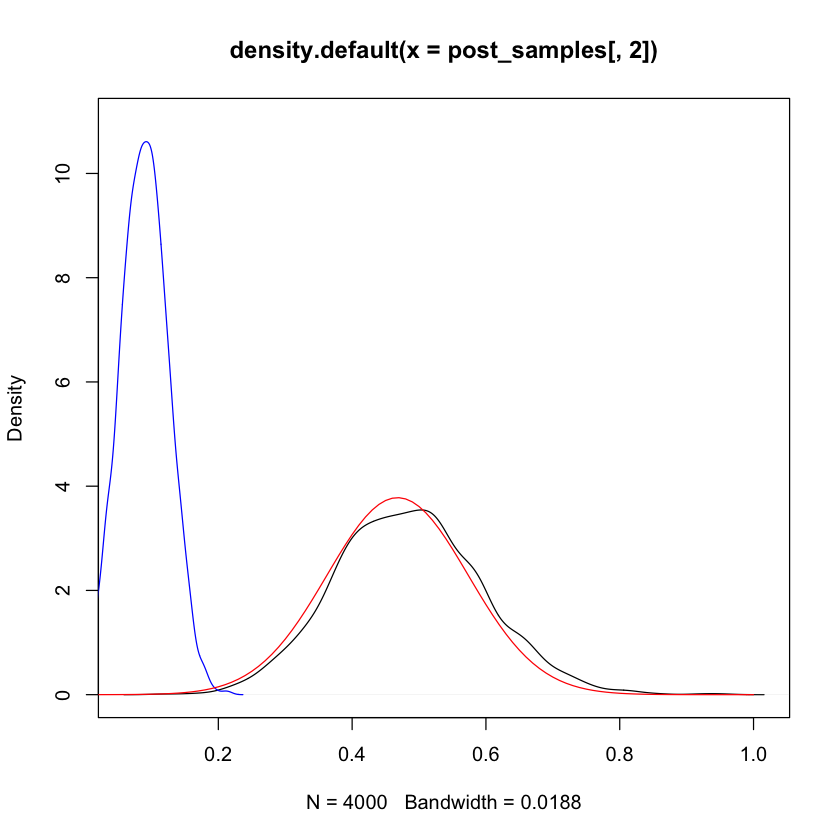
Posterior density for \(\beta_{width}\)
plot(density(post_samples[,2]), ylim=c(0,11))
lines(density(post_samples_i[,2]), col='blue') # with shrinkage
# Bernstein von Mises: using uninformative
# should look Gaussian centered at MLE...
lines(seq(0,1,length=101),
      dnorm(seq(0,1,length=101),
            mean=coef(M_crabs)[2],
            sd=sqrt(vcov(M_crabs)[2,2])),
      col='red')
mean(post_samples[,2]) # MCMC estimate of posterior mean
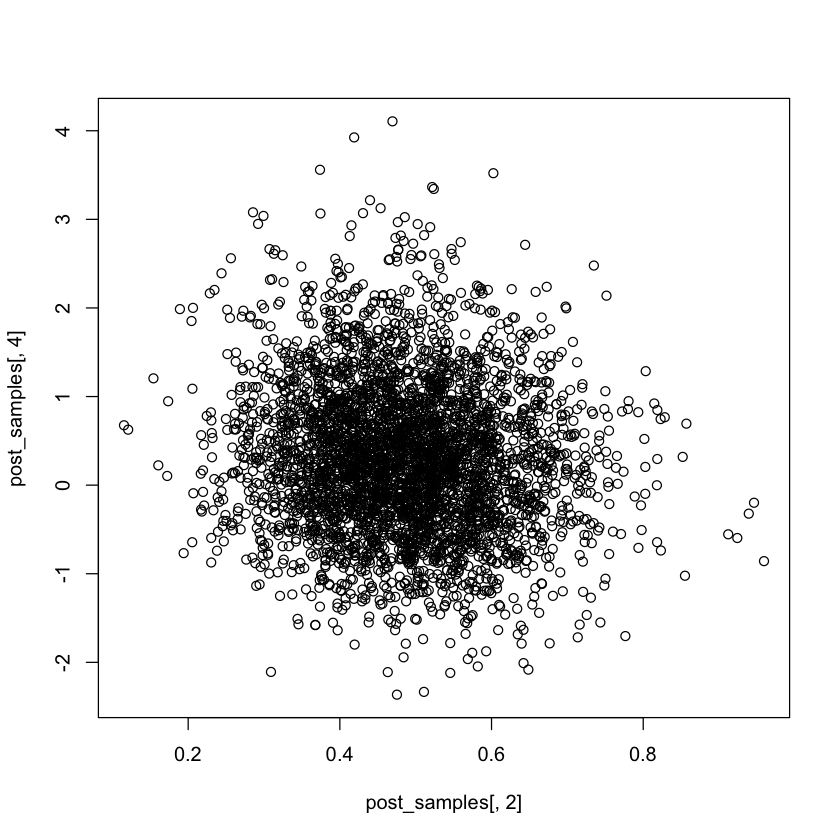
plot(post_samples[,2], post_samples[,4])
cor(post_samples)
| 1.00000000 | -0.99246293 | -0.03396606 | 0.0546337 | -0.01416269 |
| -0.99246293 | 1.00000000 | -0.03624426 | -0.1082417 | -0.08520037 |
| -0.03396606 | -0.03624426 | 1.00000000 | 0.2456596 | 0.46326579 |
| 0.05463370 | -0.10824175 | 0.24565961 | 1.0000000 | 0.36702285 |
| -0.01416269 | -0.08520037 | 0.46326579 | 0.3670228 | 1.00000000 |
Point estimates
STANcan find posterior mode / MAP estimator
rstan::optimizing(rstan::stan_model('logit_uninformative.stan'),
                  data=crabs_stan)
M_crabs$coef
- $par
- beta[1]
- -11.6205948795626
- beta[2]
- 0.468470895354146
- beta[3]
- -1.10826097789112
- beta[4]
- 0.217961072202019
- beta[5]
- 0.294121635649707
- $value
- -93.7353861463449
- $return_code
- 0
- $theta_tilde
A matrix: 1 × 5 of type dbl beta[1] beta[2] beta[3] beta[4] beta[5] -11.62059 0.4684709 -1.108261 0.2179611 0.2941216
- (Intercept)
- -11.6089904211306
- width
- 0.467955984822169
- colordarker
- -1.10612147422922
- colorlight
- 0.223797656630074
- colormedium
- 0.296214594694059